Posts tonen met het label Groningen. Alle posts tonen
donderdag 19 juli 2018
De verdediging van Friesland in 1672 en 1673
This is a great book on the fights in the tree Northern Provinces in 1672 and 1673, available free on great Delpher website. It delas with the Frisian Water Defence line, troop strengths, strategy
and gives a lot of praise to Colonel Aylva.
Click here!
Labels:
1672,
1673,
Aylva,
Delpher,
Drenthe,
Friese Waterlinie,
Friesland,
Groningen,
van Dam van Isselt
donderdag 22 februari 2018
22 februari/February 1672
On this day in 1672, one of the shops/workplace of map maker Johan Blaeu, at the Gravenstraat in Amsterdam, goes up in flames. Fortunately his other shops were saved.
Above a Blaeu map of the city of Groningen, with the 'new' fortifications. The city walls were kept intact until deep in the 19th century, when they were considered obsolete. The walls were torn down, the ditches were filled, and only from abiove you canb see where once the proud walls were standing. The many city gates were demolished, except for one, which is now in the Rijksmuseum collection.
donderdag 9 april 2015
Nieuwe Vaandels voor de schutterij
In kleur, de vaandels van de schutterij in de Stad Groningen, mid 18e eeuw.
~
In colour this time, the flags of the Groninger City Militia, mid 18th century. From the Groninger Volksalmanak.
donderdag 26 maart 2015
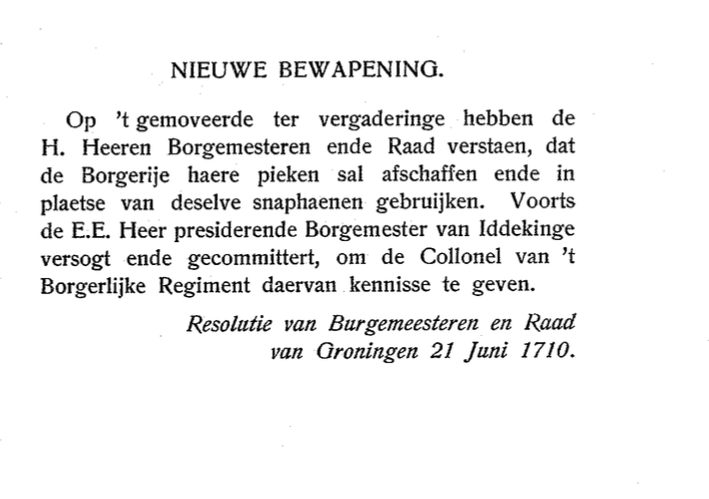
Pieken en musketten ~ Of pikes and muskets
The above text I took from the 1910 edition of the "Groninger Almanak" , a 19th century yearbook-series about "interesting things happening in the Province of Groningen", mostly historic facts about people, streetnames and the like.
This text states that the pikes, used by the city militia is to replaced by flintlocks. THis is about the same period that in the States' army the pike was to be replaced.
donderdag 26 juli 2012
Groningen 1672
Op 21 juli 1672 sloegen de bisschoppen van Keulen en Munster het beleg voor de stad Groningen. Een compagnie van 150 man studenten verdedigde naast geregelde Staatsche troepen en de schutterij de Stad. Hun vaandel is nog steeds aanwezig in het Universiteitsmuseum en boven een kopie uit de collectie van het Rijksmuseum.
~
On the 21 of July 1672 the Bishops of Munster and Cologne started their siege of the town of Groningen. The town was defended by regulars of the States' Army, the town Mililtia and a company of students of the University of Groningen. Their banner is still with us, albeit in a very bad condition, stored in the vaults of the University Museum, and the picture above is a copy of it, from the site of the Rijksmuseum. There are very few period colours left in the Netherlands, and this is one of them! The students company, also called the 'posh company', got this banner as a gift in 1667.
~
On the 21 of July 1672 the Bishops of Munster and Cologne started their siege of the town of Groningen. The town was defended by regulars of the States' Army, the town Mililtia and a company of students of the University of Groningen. Their banner is still with us, albeit in a very bad condition, stored in the vaults of the University Museum, and the picture above is a copy of it, from the site of the Rijksmuseum. There are very few period colours left in the Netherlands, and this is one of them! The students company, also called the 'posh company', got this banner as a gift in 1667.
dinsdag 3 april 2012
Vaandels/Colours WIC update

Dankzij drs C. Nicolas en een familielid van hem uit Amerika, hebben wij nu de beschikking over kleurenafbeeldingen van het vaandelboek van de West-Indische Compagnie, waarover wij eerder hier schreven.
Vanzelfsprekend zullen wij over dit boek nog verder gaan schrijven, te meer omdat over de WIC steeds meer informatie beschikbaar komt zoals deze lijst van uitgezonden militairen naar Brazilië.
De wiki over de WIC is erg goed, net als de wiki over de Groningse kamer van de WIC.
Voor nog meer info over de Groninger kamer van de WIC verwijs ik naar het boek van Prof. P.J. van Winter, "De West-Indische Compagnie ter kamer Stad en Lande", Martinus Nijhof, den Haag 1978.
~
Thanks to lt-Col Nicolas and one of his relatives in the US, we have recieved a colour copy of a book, representing colours for troops in Brazil of the Dutch West Indies Company.
We have posted earlier on this book here . Our post deals with two articles of the great Frisian historian and flag expert Klaes Sierksma on an order book, found in New York dealing with new(?) colours for the WIC troops around 1631 in Brazil, at that time a dutch colony. In his article in Mars et Historia Sierksma further analyses the book, describing the colours of the three regiments of troops "blue", "orange" and "green", each consisting of 9 companies.
A lot of extra information in the article comes from the Groninger Professor P.J. van Winter, who wrote a book on the Groninger Chamber of the WIC. Unfortunatly I haven't found van Winter's notes yet, but there's a lot of information now in the National Archives on the WIC, including a list of soldiers sent to Brazil.
The colour above, is the one of the company paid by Groninger chamber of course.
vrijdag 2 maart 2012
Kempkensberg 1672, 1700, 2012


De bovenste afbeelding is een uitsnede van het schilderij van Folkert Bock over de belegering van Groningen. Het laat waarschijnlijk Munsterse officieren zien die op de Kempkensberg het vuren der kanonnen bekijken. In 1688 werd de Kempkensberg afgegraven om plaats te maken voor de Helperlinie, die eind 19e eeuw werd afgebroken.
Rond de voormalige Kempkensberg verrezen in de tweede helft van de 20e eeuw diverse kantoren die nu weer worden afgebroken. Bij de sloopwerkzaamheden zijn restanten van de Helperlinie teruggevonden en die ziet de lezer op plaatje 2.
~
Two pics of a small hill in the south of the city of Groningen. The first one is part of a painting by Folkert Bock, showing - probably - Munster officers watching the bombardement of Groningen in 1672 staning on a small hill called the Kempkensberg. In 1688 this hill was removed to make place for a second defense line designed by Menno van Coehoorn called the Helperlinie. The Kempensberg has a long history of its own, and in the late 20th century the site was used by the Government for office buildings, notably the tax office. These buildings are gone now and replaced by a new building and during the building part of the Helperlinie was dug up, which you can see in the second pic. More on the new building which is some kind of architectural marvel here.
Labels:
1672,
Groningen,
Helperlinie,
Menno van Coehoorn
dinsdag 4 oktober 2011
1672 Gronings Studentenvaandel


Een wat betere foto van het vaandel van de Studentencompagnie, met begeleidende tekst uit de Groninger Volksalmanak uit 1838.
~
A slighty better pic from a colour of the Groninger "Student-company", which was used in 1672 as well. It's one of the few surviving 17th century colours as well, outside of the Rijksmuseum.
Note the weapon in the left hand corner of the Province of Groningen (The States of Groningen gave the colour as a gift). The colour is decribed as gold, with green/blue leaves on it.
The motto is Deo Patriae Academiae, For God, Country and the Academy (= University). The acoompagning text is from the Groninger Volksalmanak of 1838. The colour now is kept in the cellars of the University Museum.
Labels:
1666,
1672,
Groningen,
Studentencompagnie,
vaandels
dinsdag 13 september 2011
Groningen 1672 - 2011 IV
Groningen 1672 - 2011 III

Nog een uitsnede, die een uitval van de Groningers laat zien, die geïdentificeerd worden met de nederlandse driekleur. Rechts ziet de lezer een nummer 9 en rechts daarvan een schijnbaar wit vaandel met wat kriebels er op.
~~
Another cut-out, this time from the top left of Romeyn's print, it shows an attack from the defenders who are identified by the dutch red/white/blue flag. Next to it the numer "9" is shown en next to that a defenders's, probably white or light coloured flag with some scribbles on them.
Groningen 1672 - 2011 II

Nog even wat beelden van de prent van Romeyn de Hooghe. Dit is een uitsnede van de prent rechtsonder. We zien een kanon op een sorrt heuvel, versterkt met gabions, dat zijn rieten mand gevuld met zand.
Zichtbaar is een vaandel met daarop twee zwanen. Links onderaan zien we op de grote prent twee heren te paard. Rechts van hen twee gestreepte ruitervaandels met daarop een zwaan, die in de uitsnede net te zien zijn.
~~
By request I will post some more pics of the Romeyn de Hooghe print. This one is taken from the lower right hand corner. it shows a gun on some kind of hill, presumably part of the Munster Batteries, which were located on a small hill outside of Groningen. Next to the gabions a flag is visible showing two swans and two blocks.
On the left two horsemen are seen, (not in this pic for some reason) and to the right of them two standards, with stripes (could be a colour indication) and a swan on it. Three swans are part of the weapon of the Bishopric of Munster.
maandag 12 september 2011
Groningen 1672 - 2011
Bommen Berend feest gehad, feest dus! Met mislukt vuurwerk dit jaar, maar wel een heruitgave van de prent van Romeyn de Hooghe, uitgegeven door Gras, kost 6,75 euro in de boekhandel of rechtstreeks bij Gras te bestellen.
Het is een mooie afdruk geworden, met daarnaast afdrukken van nog meer bekende prenten en een hertaling van een pamflet over het beleg.
De uitsnede boven laat de beide bisschoppen zien met hun Franse en Duitse adviseurs.
Meer info hier
~~
As regular readers of this blog may know, the City of Groningen was besieged by the Munster and Cologne troops in 1672, and up to today we celebrate the relief of the Siege on August 28th.
The architecture platform GRAS has re-issued the Romeyn de Hooghe map of the siege, plus a lot of extra's for the small amount of 6,75 euro's. (link in the dutch section)
The part of the print I show here shows both the Bishops and their French and German advisors. The quality of the print is quite good.
One of the the Munster flags is partially drawn, showing swans and little white blocks on it. Another B&W flag shows a burgundian cross in the corner, and yet another shows something like a horse in the right hand corner.
maandag 20 juni 2011
Vaandels Groningen 1672

Even een kleine update: een paar maanden geleden heb ik op advies van Harry Perton eindelijk een blik geworpen in de Groninger Archieven op de in en uitgaven van de provincie Stad en Lande in 1672. Daarin een order/kwitantie voor 9 vaandels van 40 gulden het stuk, zeer waarschijnlijk bij lokale bedrijven gemaakt. (Gijvert Boelens Weijer ben ik als doopgezinde in Groningen tegengekomen.)
Hoe nu de vaandels er uit zagen is nog niet bekend. Dit kan notarieel zijn vastgelegd zoals in de Provincie Holland gebeurde, of misschien duikt er nog es een andere toegang op.
"Andere Uijtgave
Van nieuwe vaandels
De weduwe van Stoijcke Stoedenborch
Betaalt drie hindert twintigh
Gyulden voor het leveren van acgt
Vaandels en acht paar banderollen
Met sijn toe behooren, luijt ordre
En quitantie
Des Ger ..320
Gijvert Boelens Weijer betaalt
Viertigh gulden voor een nieuwe
Gelevert vaandel vande lijff
Compagnie van Zijne Excellentie Rabenhaupt
Luijt luijt ordre en qt
Des ger
Decima quarto summo van nieuwe
Vaenen bedraagt drie hinderd sestig
Gulden
Diro 360"
~
From the Groninger Archives, from the books of 1672, I dug up a financial piece of info on colours for the groninger troops. The entry deals with a payment for 8 banners to the the widow Stoedenborch, and the decond part deals with a colour for the bodyguard of His Excellency Rabenhaupt. All colours were 40 guilders each.
Unfortunatly the colours are not decribed. A description might be found in the notary archives like in the province of Holland, or maybe a chance text will show up, like in Utrecht.
zondag 13 februari 2011
Groninger Schutterij ~ City militia of Groningen
Bij ons laatste bezoek aan de Der Aa kerk in Groningen (zie boekenbeurs onder), namen wij niet alleen de gelegenheid de boeken te bekijken, maar ook het fraaie interieur. Nu weten wij dat in de Martinikerk een aparte plaats en zelfs een apart raam was gereserveerd voor de schutterij. Maar dat blijkt dus ook in de der Aa kerk het geval te zijn, gelet op bovenstaande foto's. Opvallend het stadswapen op het vaandel. Het lijkt er op dat het richting stok is verschoven, maar dat lijkt me eerder een esthetische keuze.
Zie ook hier!
~
In the post below the editors mentioned a visit to a book fair in town, which took place in the splendid Der Aa church. We took the opportunity to take a peek and we noticed the special church benches for the Militia, which also can be found in the larger Martini church in Groningen, where the militia (better: the officers from the ruling class) even has it's own church window.
Note the flag, wuth the city emblem slightly moved for esthetic reasons. It's my view the city emblem, the two headed crowned Imperial eagle with the white/green shield, was probably in the centre of the flag.
More info here!
zaterdag 8 januari 2011
Bommen Berend ~ The bombing Bishop


Op de redactie kwam deze week binnen de afstudeerscriptie van de heer drs Th. Krijvenaar over de overgang van het Staatse Leger naar het Bataafse Leger. Dat is op zichzelf al een mooi en interessant onderwerp, maat zoals het hoort is de scriptie goed onderbouwd, en van noten voorzien. Zo vond ik een referentie naar het veel geciteerde werk van Lieuwe van Aitzema en van den Bosch/Sylvius wat ook op google books te vinden is: 'Historien onses tyds, behelzende Saken van Staat en oorlogh'. De scan die google heeft gemaakt is helaas niet van al te beste kwaliteit, maar goed genoeg om over de gebeurtenissen in het jaar 1672 te lezen.
De illustraties zijn helaas niet goed ingescand, maar de meeste zijn op dit weblog aan te treffen, maar de prent van Bommen Berend vonden we zo mooi dat we hem maar weer afbeelden, mede gelet op het feit dat aan de beste man een musical is gewijd.
~
We were very pleased to recieve the master paper of historian drs Krijvenaar on the transition of the States' Army to the Batavian Army around the year 1795. This is of course a very interdsting subject of it's own, but thanks to the sound introduction we can also learn a lot on the States' Army from the 16th and 17th century.
One of the sources listed was a book called Histories of our times, concerning the State and the Wars', by the Frisian history writer and politician Lieuwe van Aitzema (I must point out that the dutch wiki is quite more elaborate than the english one, which fails ro mention that Aitzema was a spy for the english in the first and second Anglo-Dutch war, and that some of his books were banned), a series of books continued by Lambert van den Bosch, also known as Lambertus Sylvius.
The reader can find the book here on google books, and I took the liberty to reproduce one of the pages, plus a rather neat print of the Bishop of Munster, Bernard van Galen/Bernhard von Galen, who is (sort of) honoured in Groningen by a musical.
Aitzema's book gives a lot of info, ranging from court gossip, tax publications, to the mention of dutch captains of colonels who were convicted for treason.
Labels:
1672,
Garde van Galen,
Groningen,
musical,
Staatse Leger
donderdag 21 oktober 2010
Bestek 1671 ~ Government Order from 1671

Groninger historicus Harry Perton, zond mij bovengenoemde foto van een pagina, uit het bestekboek van de Staten van Groningen. Nu zijn bestekken uitermate saai, maar deze pagina is natuurlijk heel interessant.
Het betreft namelijk een order in februari 1671 voor liefst drieduizend musketten met furketten en bandoliers, en vijftienhonderd pieken met een duidelijke omschrijving van hoe een en ander gemaakt en afgeleverd dient te worden.
(Als ik mijn lees cursus heb afgerond zal ik een volledige vertaling hiervan gaan geven.)
~
Many thanks to Groninger historian Hary Perton for sending me a pic of a page from the great orderbook of the States of Stad & Lande, the province of Groningen. It deals with an order for a staggering 3000 muskets, plus bandeliers and forks, and 1500 pikes, with a detailed description on how the guns should be made and delivered. Interesting is the fact, that this order came in Februari 1671, so this shows some great foresight from the States! (A translation has to wait after I finished my course paleography, sorry!)
vrijdag 3 september 2010
Rabenhaupt's standbeeld ~ The bust of Rabenhaupt
Na bijna 350 jaar presteert de Hertog van Sucha het weer eens de gemoederen te beroeren. Ditmaal is het zijn standbeeld dat nu naast het stadhuis staat, met blik op de noordwand van de Grote Markt. Nou ja blik, als het markt is, ziet hij helemaal niks meer. Het CDA wil nu dat hij verplaatst wordt, en weer naar het zuiden kijkt. Wordt nog moeilijk om een leuk plekje voor hem te vinden.
After almost 350 year, the Duke of Sucha causes another uproar: this time it's his bust that is placed on the side of city hall. Local politicians now demand a better place for the man, but that will be difficult to find.
zaterdag 28 augustus 2010
17/27 Augustus 1672
vrijdag 27 augustus 2010
AD 1672 28. Augustus

De Lutjegaster dominee Aeldercampius, is een van de velen die in een journaal het beleg van Groningen hebben beschreven. Op woensdag de 14e Augustus oude tijdrekening was het laatste felle bombardement. Ook wordt de aankomst van Aylva vermeld, die een dag daarna weer vertrekt. Op vrijdag de 16e wordt het erg rustig en op de 17e gaan enige waaghalzen onder overste Willers al de loopgraven van de Munstersen binnen en nemen daar enige gevangenen. Op zaterdag de 28e augustus 1672 is het beleg opgeheven.
~
One of the many journals on the siege of Groningen was, written by reverend Aeldercampius from the village of Lutjegast. He describes in the part of the journal I published above, the last days of the siege, and I note that the Old Style of the calender is used, that is 10 days earlier than the one we use now.
The reverend reports that the last bombardment took place on the 24th of August, hitting the (former catholic) Martini church. Also the arrival of the Frisian Colonel Aylva is reported who is supposed to take the sconce of Nieuweschans. The shooting stopped on the 26. of August and some daredevils stormed the trenches under captain Willers, taking some prisoners. On Saturday the 28th of August 1672 the siege of the city of Groningen ended.
maandag 23 augustus 2010
Lambertus van den Bos ~ Groningen

Uit het boek 'Toneel des Oorlogs', een van de vele prenten over het beleg. Het is geen prent van Romeyn de Hooghe overigens.
Mijn dank aan Edward Wells BV, voor de toestemming om de foto van de print te reproducren. In de catalogus van Edward Wells zijn overigens nog meer mooie prenten te vinden.
From the book 'The Stage of War', by Lambertus van den Bos(ch), or Lambertus Sylvius, one of the many prints of the siege of Groningen. The google book doesn't do justice to the plate, but I got permission of Edward Wells BV, to reproduce a picture of the plate (more plates on their website), that shows up in various forms, by various authors. This one is not a Romeyn de Hooghe. Today I read the book in the university library, and the quality and the legibility of the book is astounding, considering it's almost 350 years old! Interesting to note is, that in different versions of the book, different plates are published, most of them of important people, but also maps of towns and fortresses.
Unfortunatly taking pics at the library is a bit of a problem and my iPhone has really troubles focussing, but I hope some editing will improve matters.
Abonneren op:
Posts (Atom)