Posts tonen met het label Seneffe. Alle posts tonen

zondag 11 augustus 2013

Slag bij Senef(fe) 11 augustus 1674


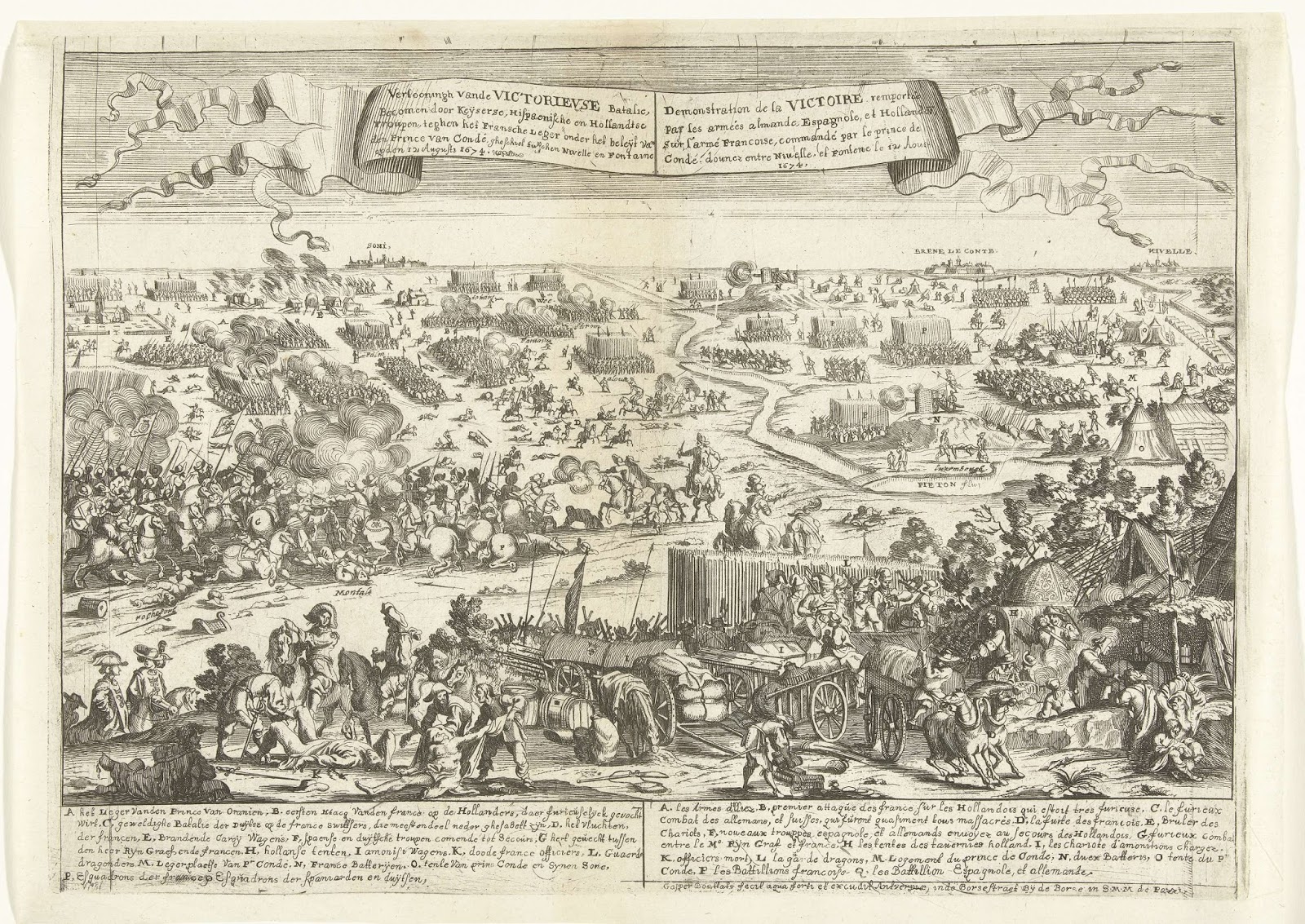
Vandaag gedenken en herdenken wij de Slag van Seneffe, 11 augustus 1674.
Plaatje komt uit het Rijksmuseum, en is gemaakt door Bouttats.

~

Today in history, the battle of Seneffe, 11th of August 1674, where the Allied army under William III was surprised but held it's own, both sides claiming victory. The picture comes from the collection of the Rijksmuseum, and is made by Bouttats.

dinsdag 12 maart 2013

Seneffe X


Ook van de KB (Knottel 11077), een uitgebreide legerlijst van het Staatse Leger uit 1674, zeer waarschijnlijk van voor de slag bij Seneffe.

~

Another print from the Royal Library, a 1674 Armylist, probably just before the battle of Seneffe. Note the mentioning of the State Deputies (in english literature unjustified maligned for obstructing Marlborough) and the artillery officers.


maandag 14 mei 2012

Chateau de Seneffe website


Prachtige nieuwe virtuele tentoonstelling over de Slag bij Seneffe, 11 augustus 1674.
Link

~
A beautiful new virtual exhibition of the Battle of Seneffe, August 11, 1674.
Link

maandag 14 november 2011

Frans Vaandel Seneffe II, French captured colour II


Nog een versie van het Franse (Leger?) vaandel, wederom van het Rijksmuseum.

~

A second version of the French (Army?) colour, captured by the allies at Seneffe. This white colour with gold embroidery was taken to a church in Brussels for display.

woensdag 26 oktober 2011

Update Rijksmuseum Seneffe II


Detail van een prent van Bouttats. Let op de ruiters met het W monogram en de vaandels van het regiment Garde te Paard. Naar mijn bescheiden mening een geel vaandel met daarop het wapen van Willem III, als afgebeeld door Hoynck van Papendrecht op de schoolplaat.


Another print from the Rijksmuseum, this time a cut out from a print by Bouttats. Note the horsmen with the W monogram, plus the standards of the Garde te Paard, the dutch Horse Guards. Looks like a yellow standard with the weapon of William III on it, as depicted earlier on Hoynck van Papendrechts 1672 school plate.

dinsdag 18 oktober 2011

Seneffe 1674 Frans Vaandel ~ French Colour


De titel en de tekst van het pamflet zeggen wel genoeg, een van de door de Geallieerden buitgemaakte Franse vaandels, als geschenk naar het hof in Brussel gebracht. Op de site van het Rijksmuseum, gevonden die ook nog een andere prent hebben, met een iets ander vaandel over hetzelfde onderwerp.

~

Well, the title says it all, a pamphlet, from the Rijksmuseum site, celebrating the gift of a captured French Royal Colour to the court in Brussels. From the Rijksmuseum, who also have another plate showing a slightly different version.

zondag 16 oktober 2011

Update Rijksmuseum Seneffe


Het Rijksmuseum is druk bezig de digitale collectie flink uit te breiden, en na het doorzoeken van zo'n 1100 afbeeldingen over vaandels (!), kwam onder andere deze prent er uit, uit 1674, uitgegeven door Sweert in Amsterdam, gemaakt door Coenraet Decker. Meer info kun je hier vinden.


The Dutch National Museum, de Rijksmuseum in Amsterdam, is quite busy digitising it's collection, and after digging all morning through the updated collection, I found the above print, drawn by Coenraet Decker on the battle of Seneffe. I also found the accompagning text, explaining the numbers on the print.

In the left hand corner, the Count of Waldeck attacked by a French officer and saved by a Polish cavalry man, who slayed the Frenchman with his ax.

More info in dutch here.

dinsdag 23 november 2010

Die andere Sonne ~ 'The Other Sun King'


Op de leestafel de dissertatie van Jutta Schumann over media-politiek onder de Roomse keizer Leopold, zoals bekend een tijdgenoot van Lodewijk XIV en Willem III. De Suddeutsche Zeitung schreef het volgende over dit boek:

Hinter diesem strahlenden Titel steckt, wie der Untertitel vermuten lässt, eine Dissertation, verrät Franziska Meier, die genau das hält, was sie thematisch vorgibt. Jutta Schumann wolle den Habsburger Kaiser Leopold I., Gegenspieler des französischen "Sonnenkönigs" Ludwig XIV. ins "rechte Licht" rücken. Er sei politisch bescheidener aufgetreten und habe auf eine aufwändige Selbstinszenierung verzichtet. Die Sonne gehörte übrigens, informiert uns Meier, auch bei den Habsburgern zum Herrscherattribut. Schumann verfahre zweigleisig, so Meier: einmal untersuche sie das Kaiserbild, wie es Zeitungen, Flugschriften, Liedern und Theaterstücken weitergaben, zum anderen beschäftige sie sich - etwas hochtrabend so genannt, findet Meier - mit den "Medienstrategien" des Kaisers, wohinter auch nichts anderes stünde als die Frage, wie das politische Handeln des Kaisers in den damals vorhandenen Medien wie Zeitungen und Flugschriften vermittelt wurde. In der Beziehung waren die Habsburger Medienmuffel, hat Meier von Schumann erfahren. Statt die Presse zu beeinflussen, verließ man sich ganz und gar auf die traditionelle Imagepflege, weshalb des Kaisers Sonne in Österreich nicht über die Landesgrenzen hinaus strahlte.


Het boek viel mij op omdat er een stukje in stond over de slag van Seneffe 1674 en hoe deze veldslag in de Duitse pers werd gezien. Opvallend de neutrale kijk op de zaken, waarbij niet alle berichten uit Den Haag of Parijs op hun woord werden geloofd.

Wat is dan winnen of verliezen? Ook Schumann wijst op de uiterlijkheden waarmee dit werd gemeten als veroverde vaandels, veroverde bagage of 'het houden van het slagveld'. Wat ik mis in het boek zijn de prenten zelf, wat het verder dan zware kost maakt.


This PhD dissertation on the 'Other Sun', Emperor Leopold of the Holy Roman Empire, deals with the media image, propaganda and press during his reign. For me it was interesting because it contained a chapter on the german reaction on the battles of Sinsheim and Seneffe, which turned out to be a rather sceptic one, as the papers didn't believe the messages from Paris or The Hague first hand. Too bad the pamhplets themselved aren't printed in the book which makes it a rather tedious read.

Above in italics a short review by the Suddeutsche Zeiting.


zaterdag 6 november 2010

Spanjaarden en Seneffe 1674 & The Spanish


Dat was wel even zoeken, naar de Spanjaarden in Augustus 1674. Bijgaand een lijstje met gevangengenomen Spanjolen, dit ter ere van hun inspanningen bij de slag en ter ere van de geboortedag van Karel de IIe.


Well, it took a while before I found some info on the Spanish, and it isn't much, but enough to honour them, and as today is the day that king Charles II of Spain was born (!), the above pamphlet.

woensdag 1 september 2010

Seneffe X


Een fraaie prent van de slag van Seneffe, behorend bij een contemporain pamflet, (TEMPO, Knottel 11088) verbeeldend de slag tussen het Franse leger en dat van de Geallieerden. de illustratie laat de dorpen Fay en Seneffe overgens niet zien, noch de Spaanse en Keizerlijke troepen, wat mij het idee geeft dat het plaatje knip- en plakwerk is, met gebruikmaking van andere afbeeldingen. De bijbehorende tekst verhaalt de spannende avonturen van de heer Vrijbergen, gedeputeerde te velde.


~

A nice plate of the battle of Seneffe, taken from TEMPO/Knottel 11088, published with a report of deputy in the Field mr Vrijbergen. I am not quite sure if this is a real illustration of the battle, as basic landmarks like the villages of Fay and Seneffe are missing and the troops look a bit dated for the 1670's. Unfortunatly the resolution of the pic is that low, that details are almost impossible to see: the flags in the lower right corner look interesting though..

woensdag 4 augustus 2010

Seneffe


Lekker ingewikkeld: de titelblad van een pamflet in Parijs (?) gedrukt, met op het einde commentaar, dat het pamflet propaganda is. Van google books.


This is the title page of a pamphlet, written in dutch, printed in Paris, hailing the French victory at Seneffe on the Spanish (!). Also added in dutch a commentary stating the pamphlet is propaganda. Complicated...

maandag 5 juli 2010

Gallica Seneffe


Het lijkt er op dat de website Gallica van de BNF zich meer en meer vult, en zo kwamen we vandaag deze prent van Seneffe tegen. Erg prijzig om na te bestellen.

~~

The French Gallica site of the National Library BNF is getting more and more info, and today I stumbled on a large pic of Seneffe, and made a cut-out of it. In Leyden there's another version of this map. Rather pricy products unfortunatly.

dinsdag 11 mei 2010

Seneffe IX


Er zijn op dit blog al diverse lijsten gepubliceerd aan de hand van contemporaire pamflette, over de troepen die aanwezig waren bij de Slag van Seneffe. Op Tempo vond ik nog een lijst met verliezen, gerangschikt naar regiment.

Vergelijk deze lijst eens met deze hier.

Opvallend is, dat ik een aantal regimenten mis: het regiment Jonge Prins Maurits, Aylva, Amana, Mornout/Mauregnault, Waldeck, Heeswijck, Mario, Brantswart, Burmania, La Verne en Coranal.

Het regiment Jonge Prins Maurits was wel aanwezig, het bezette namelijk het dorp Seneffe in het begin van de slag. Prins Maurits werd hierbij gevangen genomen. De regimenten Aylva en Amana vochten in de tweede fase, maar van de rest kon ik niks vinden. van Mornout weet ik dat dit regiment niet aanwezig was bij Seneffe, het was toen gelegerd in Gent. (Bron: M.R.H. Calmeijer, de Slag bij Seneffe)


Earlier on, I have posted several orders of battles of the States' Army at Seneffe. There is a list of the States' army on the march to the French border but I found a casualty list on TEMPO, which I have copied above. It's interesting to compare this list to the one here, and I have noticed that several regiments are missing from the list being: Young Prince Maurice, Aylva, Amana, Mornout/Mauregnault, Waldeck, Heeswijck, Mario, Brantswart, Burmania, La Verne and Coranal.

The first three regiments were at the battle (as listed in Calmeijers book on the Seneffe battle, regiment Mornout/Mauregnault was stationed in Gant at that time, but the other ones? Either thet weren't at the battle, or they were one of the few that got of lightly.


zaterdag 8 mei 2010

Tercio website ~ Seneffe


Van de website van Dr Picouet dit plaatje van een Spaanse musketier, veel meer hier plus hier een verslag van de slag van Seneffe. Voor de bronnen van dat verslag, raadpleeg dit blog.


~

The above pic comes from the excellent website of Pierre Picouet and shows a Spanish musketeer, more can be found here, and some info on Seneffe here.
The sources for that article can be found on this blog.

maandag 26 april 2010

J.W. Wijn ~ Seneffe ~ III


Summary

A battle like the one at Seneffe, must be seen in the light of it's time and age and one should realise that battles in the 16th and 17th century took a different position in warfare than today. Battles rarely where the outcome of a plan, and to characterise this, another word for battle at that time was 'occasie' or 'occasion'.

For weeks and even months enemies tried to find and encircle each other, just to find the right time and place and this is the way the battle of Seneffe started. The strategic value of these battle was zero or at least problematic. On the other hand great value was attached to appearences like captured kettke drums, flags and colours, and most importantly 'who kept the field', after the battle.

The allied army of Willam III, numbered around 60.000 men: 30.000 Dutch troops, about 12.000 Spanish of different nationalities, and 20.000 Imperial troops. The Spanish troops were commanded by the Monterey, the stadholder of the Spanish Netherlands, and the Imperialists were under De Souches. Especially de Souches caused a lot of problems because he had secret orders not to interfere in battle.

The French, numbering about 45.000 men, were under the great Condé, and were in the minority. Conde had a fortified camp behind the Pieton river. William himself tried to convince his commanders to go to battle, but this was refused so the army marched south to the French border. The allies moved a bit more to the French lines to scout Condé's position but somewhat in a hurry the army broke camp and went south on the 11th.

This turned out to be a rather bad idea: marching under the eye of the enemy, especially Condé, through rough terrain was asking for trouble. And trouble came.

Condé found out about the plans of the allied army already on the 10th. On the 10th he already moved cavalry and infantry over the river Pieton, and the next day he moved to a position to watch the allied army. He immediatly ordered an attack to the rear guard of the allies, with cavarly, infantry and six artillery pieces under de Montal. Condé himself commanded the Maison du Roi and crossed the river up north.

This was noticed by the prince of Veaudemont, a man from Lorraine in Spanish service and his dragoons, who asked William for reinforcements and three bataillions Dutch went to Seneffe to defend the village. Near Seneffe the first phase of the battle started and the allies were driven out the village which was very difficult to defend. At least three dutch bataillons were beaten, 'Young' Prince Maurice was captured, but Montal was wounded himself as well. The French pushed on, causing a rout of the allies. In a position north of Condé, general Fourilles moved his cavalry, smashed the dutch Nassau Friesland regiment who were guarding the baggage train and who fled into the baggage train. The French followed them and paid their attention to the baggage and started looting.

Condé started to push on to the allied rear guard, consisting of 16 squadrons under the marquis of Assentar, the duke of Villa Hermosa and only one bataillion of infantry under Beaumont. Monterey took the rest of the infantry to the avant-garde, 'took a wrong turn' and turned up the next day after the battle.

The van Weede brigade, about 12 bataillions, fortunatly started covering the retreat of the Spanish, and both sides were in confusion and new lines started to appear after the troops were rallied.

The French attacked again: on the right Luxembourg, in the centre Fourilles and on the left Condé with the Maison du Roi. Near the convent of St Nicolas du Bois a fierce battle started, the decond part of the battle of Seneffe: Condé managed to break through the center, the French infantry arrived and attacked from the east and despite the personal courage of William the allied were pushed back again. Amongst the dead were Col. Aylva and Spanish commander de Assentar. Up to now, about 45 allied squadrons and 18 batallions were beaten.


But still, three Dutch brigades were intact plus some cavalry. Also, the Imperial troops were not involved in the battle, either through unwillingness as dutch writers state, or the actions of french general St Clas, who was snet out to Condé to harras the avant-garde.

William managed to make a new defensive line near the village of Fay, with the dutch on the right in the East and the imperialist on the left. Also the artillery was deployed.

Again fierce fighting started. Fay was well defendable position, skrimishers were deployed in the hedges and cavalry was used a a mobile defense by the allies. The French attacked the village but failed to move on. Luxembourg managed to near the artillery but was pushed back by a counter attack. He was himself attacked by Fariaux, the defender of Maastricht.

On the other flank, near Hestre, the dutch were pushed back by Navailles, but he again was attacked by John Maurice 'The Brazilian'. Fighting continues until dark, all the French attacks were repulsed. After midnight Condé ordered his troops to leave the field.

Historians agree that the battle was one of the bloodiest in the 17th century and it is estimated that both sides recieved about 3000 casualties. The French claim about 3.500 prisoners and the capture of at least 107 colours, plus 40 pontoons and a large part of the baggage train.

The allies state that they left the field two hours after the french, and that they reached their marching target. The last attack of the French was beaten, but the attack on France itself had to be postponed. The batte therefore was undecided.


Original text (c) Ons Leger / Translation (c) rampjaar.blogspot.com

J.W. Wijn ~ Seneffe 1674 ~ II


(c) Ons Leger

J.W. Wijn ~ Seneffe 1674 ~ I


De historicus J.W. Wijn schreef voor het maandblad 'Ons Leger' bovenstaand artikel, wat ik met toestemming hier reproduceer.

(c) Ver. Ons Leger, bron: Ons Leger, 1952 Vol 36, delen 2-2


~~

Dutch historian J.W. Wijn, (author of part VIII of 'Het Staatsche Leger') wrote the above article for the peridodical of dutch organisation 'Ons Leger' ('Our Army'), in 1952, and I have been granted permission to republish it here.

Wijn is a very thorough historian and a good writer as well.

I won't translate the entire article, but will make a summary of it, unless there's a really great demand for it.

The first pic is a Romeyn de Hooghe print and the second one is drawing of the battle itself by Wijn.

(c) Ons Leger, source 'Ons Leger', 1952, Vol 36, parts 2-3

woensdag 7 april 2010

Seneffe VIII


In verband met een storing bij Ziggo is het internetten de laatste dagen nu niet bepaald erg prettig, zeker als je met grote bestanden moet werken.

Maar goed, nog een kaart van de slag bij Seneffe, wederom uit de collectie van de universiteitsbibliotheek Leiden. Let op de wagentjes en de aanval op de artillerie.


My internet connection has some issues, so uploading large image files isn't a pleasure at all at the moment. But, in between I managed to upload another map of the Seneffe battle of 1674, courtesy and copyright of the University of Leyden. Note the baggage wagons and the attack on the artillery.

zondag 4 april 2010

Seneffe VII


Eindelijk binnen, vanuit de Leidse Universiteits bibliotheek een contemporaire kaart van de slag van Seneffe. Het wachten meer dan waard, de scans zijn geweldig (120 MB!).

Met dank aan lezer Lysimachus een vertaling van de tekst/legenda bij de kaart.

TEXTE ORIGINAL

Bataille de Seneffe
donné entre larmée de frances et selles de monseigneur le praince Dorange

A Le camp de monseigneure le praince dorange composes des troupe imperialle & despagne
1 le village darkeme
2 village la où le praince maurisse loga et le marquis de la santaro
B le camp de larmee francoise commandee par monsieure le praince de Conde
C le camp du duque de Luxembourg qui arrivat le soir de la bataille
3 la garde avansees des hollandois
D lendroit ou les francois ce mire en bataille avans de combatre
F la marche de troupes

FRANÇAIS MODERNE

Bataille de Seneffe
donnée entre l’armée de France et celle de monseigneur le prince d’Orange

A Le camp de monseigneur le prince d’Orange composé des troupes impériales & d’Espagne
1 le village d’Arkeme
2 village la où le prince Maurice loga et le marquis de la santaro
B le camp de l’armée française commandée par monsieur le prince de Condé
C le camp du duc de Luxembourg qui arriva le soir de la bataille
3 la garde avancée des hollandais
D l’endroit où les français se mire en bataille avant de combattre
F la marche de troupes

ENGLISH VERSION
Battle of Seneffe
Fought between the army of France and the one of the Prince of Orange

A The camp of Prince of Orange composed of the imperial troops and the Spanish ones
1 the village of Arkeme
2 village where Prince Maurice slept and the marquis of Santaro
B The camp of the French army commanded by the Prince of Condé
C The camp of the duke of Luxembourg who arrived on the evening of the battle
3 The advanced guard of the Dutch
D the place where the French moved in battle formation before the fight
F The march of troops


~~

At last my mail from Leyden arrived, showing a contemporary picture of the battle of Seneffe. Excellent service from the University of Leyden Library, making scans of 120MB! many thanks to reader Lysimachus who offered a translation of the text/legenda from 17th century French to English and modern French.


vrijdag 12 maart 2010

Seneffe VII


Mijn grote dank aan lezer Lysimachus een legerlijst/order of battle van de Franse zijde.

(De afbeelding is van het stadje Nieuwegein, waarschijnlijk 17e eeuws met een frans opschrift. Heeft verder niks met Seneffe te maken).


Many thanks to the esteemed reader Lysimachus, who was kind enough to give me the French Order of Battle of Seneffe.
(
The picture comes from the website of the council of Nieuwegein, a town on the dutch water defense line, which I found using google. Looks like a late 17th drawing with French text.)


Armée complète 44 500 soldats (1 régiment CAV = 6 compagnies = 2 escadrons)
(1 bataillon INF théorique = 800 hommes)
(1 compagnie INF = 60 hommes depuis ordre du 20/10/1673)
Louis de Bourbon, Prince de Condé

Lieutenants généraux:
- Duc d’Enghien
- Duc de Navailles
- Duc de Luxembourg
- Comte de Rochefort
- Chevalier de Fourilles

Maréchaux de camp :
- Marquis de Villeroy
- Marquis de Choiseul
- Comte Broglio
- Comte de Revel
- Comte de Montal
- Comte de Königsmarck
- Monsieur de la Cardonnière

INFANTERIE
8 brigades: 30 000 – 31 000 foots
50 bataillons (27 régiments)
Gardes françaises, Gardes suisses, Picardie, Navarre, Normandie, Auvergne, Bourbonnais, Touraine, Le Roi, Orléans, La Reine, Limousin, Royal des vaisseaux, Artois, La Fère, Alsace (1er bataillon), Royal italien, Condé, Bourbon, Montpeyroux, Vermandois, Salm-Salm, Stuppa, Salis-Zizers, Pfiffer

CAVALERIE
9 brigades (109 escadrons) 13 000 chevaux
- La Maison du Roi 11 escadrons (Gardes du Roi-4 cmp de 400, Gendarmes de la Garde-1 cmp de 200, Chevau-légers de la Garde-1 cmp de 200, Mousquetaires-2 cmp de 200)
- Gendarmerie 8 escadrons (total 1280 hommes)
- 34 régiments of Chevaux légers
Cuirassiers du Roi, Mestre de camp général, Commissaire général, Royal cravates, Prince de Piémont (408 Royal Piémont), Königsmark (410), Royal Pologne, Royal Normandie, La Reine, le Dauphin, Condé, Enghien, Conti, Arnolfini (366), Bligny (365), Calvo (293), Estrades (375), la Feuillée (298), Florensac (354), Fourilles, Gournay (400), L’Houmeau (415), la Illière (444), Kercado (372), Montal (439), Méré (392), Pelleport, Resnel, Rosen (47), Saint-Loup (264), Schomberg, Sourdis (361), Tilladet (364), la Valette (246), Nonant (303), Vivans (368)

DRAGONS
2 régiments de dragons 1200 dragons
- Colonel général
- Sauveboeuf

ARTILLERIE
60 canons (24, 12, 8, 4) Sous le commandement du commissaire Barbier du Metz (adjoint Monsieur de la Frézelière)
Fusiliers du Roi
Corps de couverture à Fontaine Levêque
Maréchaux de camp Comte de Bardi-Magalotti et Comte de Montauban
INFANTERIE :
Royal-Italien, Douglas, La Couronne, La Grézelière, Jonzac, Bourlémont, Roussillon

CAVALERIE :
Lançon (434), Roucherolles, Béthune, Auger, Ollier (274), Ménil-Montauban (454), Servon (337), Bertillat (395)

Diversion à Haine Saint-Paul
Brigade de Saint-Clas :
5 régiments de cavalerie
Dauphin, Arnolfini (366), Saint-Aoust (426), Saint-Clas (413), Revel

Combat de Seneffe (10am-12am)

Grand garde
Rive droite
Brigade INF
La Reine, la Fère 2500
Brigade CAV de Tilladet : 1500
4 régiments de cavalerie
Royal cravates, Tilladet, Gournay, Courcelles
ART
Fusiliers du Roi (1 bataillon)
6 pièces de 4 livres

Rive gauche
INF
Navarre
CAV 3000
Maison du Roi
Cuirassiers du Roi
DRAGONS
Colonel-Général 1200

Bataille de Fayt (3pm-12pm)

Aile droite : 48 escadrons et 2 bataillons
Duc de Luxembourg (maréchaux de camp : marquis de Choiseul, Comte de Revel)
Marquis de la Trousse
Gardes du Corps
Gendarmes
Chevau-légers

Marquis de Sourdis, Comte de la Feuillée
Cuirassiers du Roi
16 régiments CAV: Commissaire général, Catheux, Ragny, Rosen, Estrades, Sourdis, Saveuse, Schomberg, Rohan, Condé, Varennes, Orléans, la Feuillée, Bligny, la Valette, Vivans

Infanterie :
Picardie (2 bataillons)

Corps de bataille : 35 battalions
Louis de Bourbon, Prince de Condé
Colonne de droite :
M. de Rubantel
Gardes françaises, gardes suisses
Colonne du centre:
Comte de Gacé-Vermandois
Navarre, la Reine, le Roy, Royal des Vaisseaux
Colonne de gauche :
M. de la Mothe
Auvergne, Conti, Condé, Enghien
Colonne de réserve :
Stuppa, Salis-Zizers, Pfiffer, Erlach

Aile gauche : 48 escadrons et 1 brigade INF
Duc de Navailles (maréchal de camp : Comte de Königsmark)
18 régiments CAV : Mestre de camp général, Calvo, Kercado, Nonant, Muret, Saint-Germain, Dauphin, Arnolfini, Saint-Aoust, Saint-Clas, Revel, Royal-Cravates, Tilladet, Gournay, Courcelles, Enghien, Paulmy, Königsmark

Régiments possibles pour Susane :
391, 412, 414, 420