Posts tonen met het label 1674. Alle posts tonen

zondag 11 augustus 2013

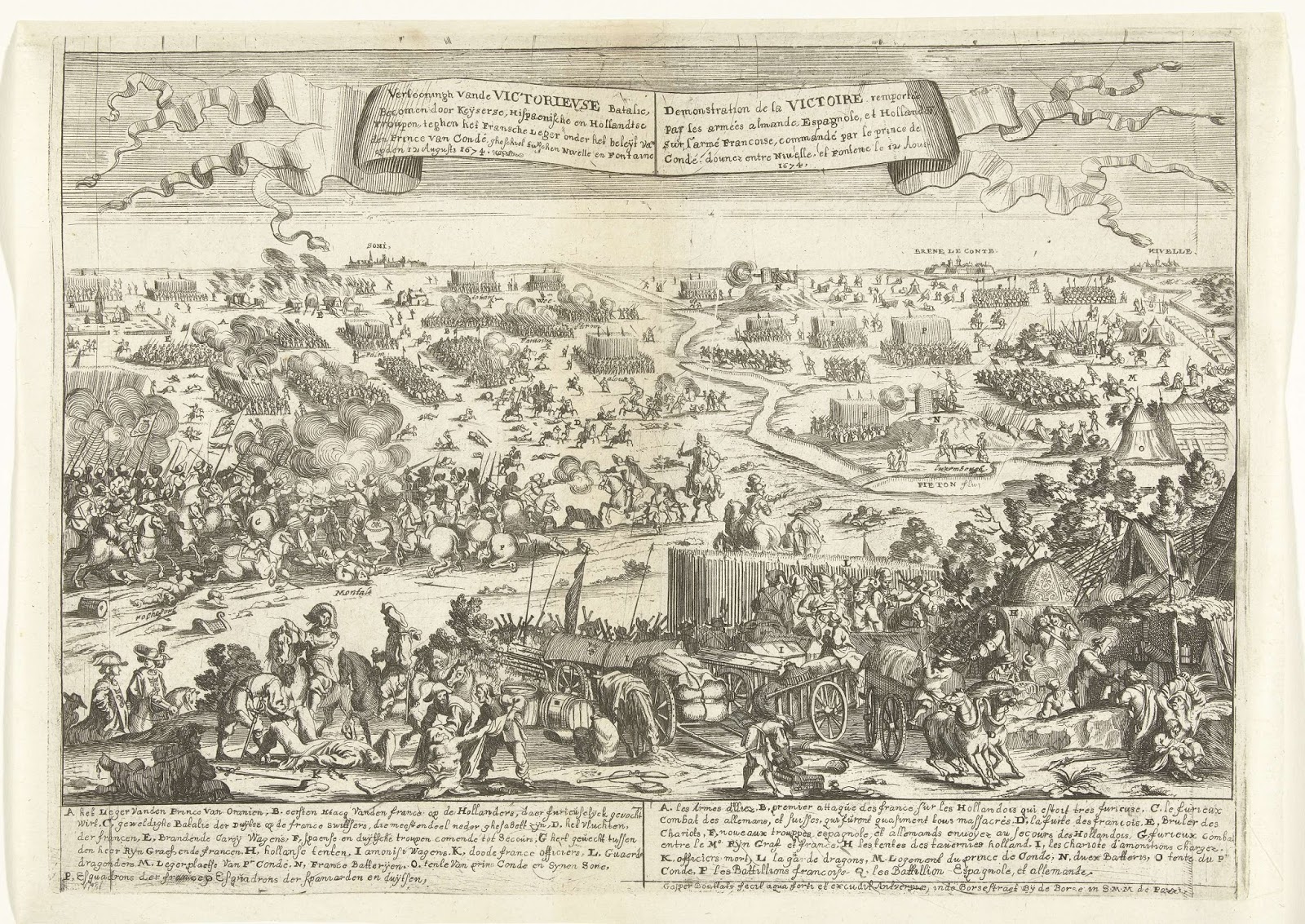
Slag bij Senef(fe) 11 augustus 1674


Vandaag gedenken en herdenken wij de Slag van Seneffe, 11 augustus 1674.
Plaatje komt uit het Rijksmuseum, en is gemaakt door Bouttats.

~

Today in history, the battle of Seneffe, 11th of August 1674, where the Allied army under William III was surprised but held it's own, both sides claiming victory. The picture comes from the collection of the Rijksmuseum, and is made by Bouttats.

dinsdag 12 maart 2013

Seneffe X


Ook van de KB (Knottel 11077), een uitgebreide legerlijst van het Staatse Leger uit 1674, zeer waarschijnlijk van voor de slag bij Seneffe.

~

Another print from the Royal Library, a 1674 Armylist, probably just before the battle of Seneffe. Note the mentioning of the State Deputies (in english literature unjustified maligned for obstructing Marlborough) and the artillery officers.


maandag 14 mei 2012

Chateau de Seneffe website


Prachtige nieuwe virtuele tentoonstelling over de Slag bij Seneffe, 11 augustus 1674.
Link

~
A beautiful new virtual exhibition of the Battle of Seneffe, August 11, 1674.
Link

maandag 14 november 2011

Frans Vaandel Seneffe II, French captured colour II


Nog een versie van het Franse (Leger?) vaandel, wederom van het Rijksmuseum.

~

A second version of the French (Army?) colour, captured by the allies at Seneffe. This white colour with gold embroidery was taken to a church in Brussels for display.

woensdag 26 oktober 2011

Update Rijksmuseum Seneffe II


Detail van een prent van Bouttats. Let op de ruiters met het W monogram en de vaandels van het regiment Garde te Paard. Naar mijn bescheiden mening een geel vaandel met daarop het wapen van Willem III, als afgebeeld door Hoynck van Papendrecht op de schoolplaat.


Another print from the Rijksmuseum, this time a cut out from a print by Bouttats. Note the horsmen with the W monogram, plus the standards of the Garde te Paard, the dutch Horse Guards. Looks like a yellow standard with the weapon of William III on it, as depicted earlier on Hoynck van Papendrechts 1672 school plate.

dinsdag 18 oktober 2011

Seneffe 1674 Frans Vaandel ~ French Colour


De titel en de tekst van het pamflet zeggen wel genoeg, een van de door de Geallieerden buitgemaakte Franse vaandels, als geschenk naar het hof in Brussel gebracht. Op de site van het Rijksmuseum, gevonden die ook nog een andere prent hebben, met een iets ander vaandel over hetzelfde onderwerp.

~

Well, the title says it all, a pamphlet, from the Rijksmuseum site, celebrating the gift of a captured French Royal Colour to the court in Brussels. From the Rijksmuseum, who also have another plate showing a slightly different version.

zondag 16 oktober 2011

Update Rijksmuseum Seneffe


Het Rijksmuseum is druk bezig de digitale collectie flink uit te breiden, en na het doorzoeken van zo'n 1100 afbeeldingen over vaandels (!), kwam onder andere deze prent er uit, uit 1674, uitgegeven door Sweert in Amsterdam, gemaakt door Coenraet Decker. Meer info kun je hier vinden.


The Dutch National Museum, de Rijksmuseum in Amsterdam, is quite busy digitising it's collection, and after digging all morning through the updated collection, I found the above print, drawn by Coenraet Decker on the battle of Seneffe. I also found the accompagning text, explaining the numbers on the print.

In the left hand corner, the Count of Waldeck attacked by a French officer and saved by a Polish cavalry man, who slayed the Frenchman with his ax.

More info in dutch here.

zondag 16 januari 2011

Groningen Bouttats 1674


Groeningen, the Capital of the Landscape of Groeningen and the Ommelanden (lit: surrounding land) , lays on the river Schuytendiep, three large miles from Delfs-Ziel, and six from Leeuwaerden, it is a well inhabited Town, with rich houses and beautiful manors, who thrive in trade, and have great freedom from their Rulers, doing Civil and criminal justice, without any preceding permissions. In the year 1580, the Count of Rennebergh, secured the town for the King of Spain; though it came into possession of the United Provinces by Prince Maurice; they enlarged the city in the year 1614, and with 17 bulwarks and deep moats it was strengthened. In the year 1672 it was besieged by the Bishops of Kur Cologne and - Munster on the 9. of Juli, but they had to leave the town, which was destroyed for a third by hot bullets or otherwise, the 17th of August of the same year.

woensdag 12 januari 2011

Thoneel der Steeden ~ Showcase of cities in the Netherlands


Als je van stedenprenten houdt (zoals wij) en als je van Nederlandse of Vlaamse steden houdt (zoals wij) dan is dit boek van Casper Bouttats uit 1674 een noodzakelijke aanschaf. Mooie prenten met vaak verkeerde teksten, rare afbeeldingen en perspectieven maar wel leuk afgebeelde boeren, burgers en buitenlui. Een gemiddelde prent kost zo'n 150 euro per stuk, maar de nadruk uit de jaren 1970 van het hele boek is zo rond de 30 euro.

~

For those who like pictures of cities and towns, and especially for those who like dutch and flemish cities and towns, the works of Caspar Bouttats from Antwerp are a must. His book 'Thoneel der Steeden', gives various pictures of towns and fortresses of the Republic, with amusing (and sometimes wrong) accompanying texts, and wierd perspectives. Nice pictures of farmers, city-dwellers and noblemen and -women.

zaterdag 18 december 2010

Grave 1674 III


Met dank aan het British Museum, nog een prent van het bloedige beleg van Grave. Let op de details als de kampementen, de geschutstellingen en het marcheren van de troepen links boven.

~

Again, my thanks to the trustees of the British Museum, for this plate dealing with the bloody siege of the town of Grave. Note the nice details like the tents, the gun emplacements and the marching troops in the upper left corner.


donderdag 25 november 2010

Kaas ~ Cheese


Dit fraaie schilderij (Collectie Stedelijk Museum Alkmaar) , van een onbekende maker, stelt de Kaasmarkt voor in Alkmaar. Het schilderij dateert uit 1660 en bevindt zich in het Stedelijk Museum te Alkmaar, van wie ik toestemming heb gekregen dit plaatje te plaatsen.

Het mooie van dit schilderij is dat duidelijk te zien is wat de dracht van die tijd was: we zien schippers met kniebroeken, serieuze heren in 't zwart met platte hoeden, we zien bontmutsen, dames in klederdracht en veel capes. Hoe meer je het schilderij bekijkt hoe meer details je er op ziet.

In de collectie van de Provinciale Atlas van Noord-Holland bevindt zich een ets van Romeyn de Hooghe uit 1674, die verdacht veel lijkt op dit schilderij. Qua compositie, onderwerpkeuze, de gebruikte figuren lijken de afbeeldingen zo op elkaar dat we wel moeten aannemen dat Romeyn de Hooghe leentjebuur heeft gespeeld.


Een familie met rechts onder een kinderwagen.


Twee militairen met de typische dracht uit het beginf van de jaren 1670: opvallend de korte mouwen.


Een detail wat op het schilderij wat moeilijker is te zien.

~

Many thanks to the Stedelijk Museum of Alkmaar, for letting me reproduce a picture of the painting 'View on the Weighing Building', dated 1660, unknown artist. It shows the cheese market in Alkmaar with great detail and I really love the way the artist show the people on the market with their traditonial clothing, parts of which survived up to the 20th century. Note the Burgers in the typical Holland black clothes, the capes, the fur hats and the smoking woman.

As a comparison, I show (without permission) some snapshots of an etching by Romeyn de Hooghe from 1674. The full picture can be found here, at the website of the North-Holland Provincial Atlas, and it is quite obvious that Romeyn was heavily 'inspired' by the painting. Again, a lot of detail can be seen on the etch, like the above family, the two soldiers with the typical short sleeved overcoat of the early 1670's and the writing on the building. (It's in Latin and it means 'Courage and power gave the City and People of Alkmaar the right to weigh again'. In the building goods were weighed for trade. This was one of the typical city rights, just like the right to have a market or to transfer goods.)


dinsdag 23 november 2010

Die andere Sonne ~ 'The Other Sun King'


Op de leestafel de dissertatie van Jutta Schumann over media-politiek onder de Roomse keizer Leopold, zoals bekend een tijdgenoot van Lodewijk XIV en Willem III. De Suddeutsche Zeitung schreef het volgende over dit boek:

Hinter diesem strahlenden Titel steckt, wie der Untertitel vermuten lässt, eine Dissertation, verrät Franziska Meier, die genau das hält, was sie thematisch vorgibt. Jutta Schumann wolle den Habsburger Kaiser Leopold I., Gegenspieler des französischen "Sonnenkönigs" Ludwig XIV. ins "rechte Licht" rücken. Er sei politisch bescheidener aufgetreten und habe auf eine aufwändige Selbstinszenierung verzichtet. Die Sonne gehörte übrigens, informiert uns Meier, auch bei den Habsburgern zum Herrscherattribut. Schumann verfahre zweigleisig, so Meier: einmal untersuche sie das Kaiserbild, wie es Zeitungen, Flugschriften, Liedern und Theaterstücken weitergaben, zum anderen beschäftige sie sich - etwas hochtrabend so genannt, findet Meier - mit den "Medienstrategien" des Kaisers, wohinter auch nichts anderes stünde als die Frage, wie das politische Handeln des Kaisers in den damals vorhandenen Medien wie Zeitungen und Flugschriften vermittelt wurde. In der Beziehung waren die Habsburger Medienmuffel, hat Meier von Schumann erfahren. Statt die Presse zu beeinflussen, verließ man sich ganz und gar auf die traditionelle Imagepflege, weshalb des Kaisers Sonne in Österreich nicht über die Landesgrenzen hinaus strahlte.


Het boek viel mij op omdat er een stukje in stond over de slag van Seneffe 1674 en hoe deze veldslag in de Duitse pers werd gezien. Opvallend de neutrale kijk op de zaken, waarbij niet alle berichten uit Den Haag of Parijs op hun woord werden geloofd.

Wat is dan winnen of verliezen? Ook Schumann wijst op de uiterlijkheden waarmee dit werd gemeten als veroverde vaandels, veroverde bagage of 'het houden van het slagveld'. Wat ik mis in het boek zijn de prenten zelf, wat het verder dan zware kost maakt.


This PhD dissertation on the 'Other Sun', Emperor Leopold of the Holy Roman Empire, deals with the media image, propaganda and press during his reign. For me it was interesting because it contained a chapter on the german reaction on the battles of Sinsheim and Seneffe, which turned out to be a rather sceptic one, as the papers didn't believe the messages from Paris or The Hague first hand. Too bad the pamhplets themselved aren't printed in the book which makes it a rather tedious read.

Above in italics a short review by the Suddeutsche Zeiting.


woensdag 1 september 2010

Seneffe X


Een fraaie prent van de slag van Seneffe, behorend bij een contemporain pamflet, (TEMPO, Knottel 11088) verbeeldend de slag tussen het Franse leger en dat van de Geallieerden. de illustratie laat de dorpen Fay en Seneffe overgens niet zien, noch de Spaanse en Keizerlijke troepen, wat mij het idee geeft dat het plaatje knip- en plakwerk is, met gebruikmaking van andere afbeeldingen. De bijbehorende tekst verhaalt de spannende avonturen van de heer Vrijbergen, gedeputeerde te velde.


~

A nice plate of the battle of Seneffe, taken from TEMPO/Knottel 11088, published with a report of deputy in the Field mr Vrijbergen. I am not quite sure if this is a real illustration of the battle, as basic landmarks like the villages of Fay and Seneffe are missing and the troops look a bit dated for the 1670's. Unfortunatly the resolution of the pic is that low, that details are almost impossible to see: the flags in the lower right corner look interesting though..

zaterdag 28 augustus 2010

Martinique 1674


Franse prent over de aanval van de Ruyter op Martinique. Uit de BNF, de referentie is handgeschreven in de kantlijn, dank aan drs C.B. Nicolas.


A french drawing of the attack on Martinique, courtesy of the BNF and drs C.B. Nicolas.


vrijdag 27 augustus 2010

Martinique 1674


Eerder heb ik een verwijzing gemaakt naar een aantal artikelen van drs C.B. Nicolas over het avontuur van de Ruyter op Martinique in 1674.

Het laatste woord is toch nog niet gezegd over de grootschalige operatie in de Cariben, zo wist drs Nicolas mij te vertellen. Boven een plaatje uit TEMPO 11109, het scheepsjournaal van het schip de Prins te Paerd, wat een vrij neutraal verslag is van de gebeurtenissen die in de Franse kronieken als een enorme overwinning wordt gevierd.

Een ander interessant punt is het gebruik van de vaandels. Ik kom dan weer terug op dit vaandel, het vaandel van (toen) regiment van Beveren.


Dit is een plaat uit de collectie Ten Raa van het Legermuseum. Deze plaat is gemaakt naar een voorbeeld wat in de BNF ligt en die zijn gemaakt door de Oostenrijkse historicus Norbert Robitscheck. Hoe deze nu in Frankrijk terecht zijn gekomen is me nog niet helemaal duidelijk. Het kan zijn dat Gustave de Ridder deze in opdracht heeft laten maken, het kan ook zijn dat ze gemaakt zijn naar een voorbeeld. Het bijzondere aan dit vaandel is weer, en dat is mijn kritiek op bijna alle Robitscheck platen, is dat hij heraldisch niet klopt (vooral de 'tierelantijnen') en dat op het vaandel liefst drie verschillende families Beveren worden afgebeeld! Het is ook niet duidelijk of dit vaandel is meegenomen naar Martinique omdat dit (kleurige) vaandel verder nergens beschreven wordt, dit in tegenstelling tot de vaandels die wel meegingen.

Wordt vervolgd dus!

~~

Earlier on I have posted a reference to the raid of de Ruyter on the French held isle of Martinique in the Caribbean. it has come to my attention that the last word on it hasn't been said, especially on the results and outcome of the raid. Above I have posted one of the sources, the ship's journal of 'De prins te Paard' ('The Prince on Horseback'), which gives a rather neutral report, in contrast to the French sources who claim a big victory.

There's also the matter of the 'missing colour'. Some sources claim that a colour was captured and taken to France. Unfortunatly no trace has been found of the colour and the only picture of a period colour could be a colour of Regiment van Beveren, later Uytenhove, one of the regiments present at Martinique. The picture comes from the Ten Raa collection, and is a copy of the BNF pictures from the collection of Gustave de Ridder, made by the Austrian Historian Norbert Robitscheck. At this time I have great doubts about the authenticity of these plates. Alas, we know almost nothing about Robitscheck and his sources, so we still have to fall back on books like 'Les Triomphes de Louis XIV'.

To be continued!

zondag 22 augustus 2010

Kaarten ~ Maps


Een hele mooie kaart van de Republiek in 1674. heel duidelijk is te zioen hoe de Noordelijke Provincies te bereiken zijn dankzij of ondanks de moerassen bij de grens. Houd je echt van kaarten, dan is een bezoekje aan de Staverder Map Fair een leuk idee.


A very nice map from the year 1674 of the Dutch Republic. It shows clearly how the marshes and swamps limit your access to the Northern Provinces. On strategic points, therefore the places where you could move/walk/ride without getting the risk of nasty diseases or the risk of getting lost or drowned, forts were places like Coevorden, Bourtange and Ommen. More maps to be had at the Staverder fair.

maandag 9 augustus 2010

Berckheyde, Amsterdam & 1690


De Amsterdamse grachtengordel, als geschilderd door de Haarlemmer Berckheyde, is op 1 augustus 2010 op de UN Werelderfgoedlijst geplaatst. Berckheyde heeft kort na de aanleg, of beter gezegd uitleg een aantal schilderijen van de grachten gemaakt, waar de lezer hier wat meer over kan vinden.

Berckheyde maakte ook schilderijen ober Haarlem. Op het 1690 blog van Dan Harper vond ik een verwijzing naar een schilderij uit 1674 (en niet 1679) met daarop enige heren afgebeeld, zeer waarschijnlijk militairen.

Van dat schilderij nóg een meneer die me een militair lijkt.


Als ik wat meer tijd heb, zal ik proberen te achterhalen welk regiment toen gelegerd was in Haarlem.


~~

The Amsterdam Canal District has been placed on the UN World Heritage List, and the Amsterdam Rijskmuseum has several nice articles on it's website on this remarkable feat of urban planning. (Here is one).

The paintings on the Rijksmuseum are made by Haarlem painter Berkcheyde. I found on Dan Harper's 1690 blog a nice reference to a 1674 (not 1679!) painting of the Market Place and Grote kerk (litt: 'Big Church'), showing probably a soldier with his ladyfriend.

From that painting I took another pic, showing another military man, this time dressed in an unfashionable non-fitting grey coat (some of the other men in the pic are dressed more fashionable) with short sleeves. If I have more time on my hands I will try to find out which unit was garrisoned in Haarlem at that time.


maandag 5 juli 2010

Gallica Seneffe


Het lijkt er op dat de website Gallica van de BNF zich meer en meer vult, en zo kwamen we vandaag deze prent van Seneffe tegen. Erg prijzig om na te bestellen.

~~

The French Gallica site of the National Library BNF is getting more and more info, and today I stumbled on a large pic of Seneffe, and made a cut-out of it. In Leyden there's another version of this map. Rather pricy products unfortunatly.

vrijdag 2 juli 2010

Rabenhaupt in Veldhausen 1674 III


Uit: Johann David Köhlers, Muntenboek, Volume 10


From a 1738 book on coins and history by Johann David Kohlers, a quote on the proceedings of the belligerents in 1674 being:


'Whilst in the year 1674, the Bishop of Munster, entered the frozen land and water of the Province of Groningen, via the Monestary of Ter Apel with a thousand man on horse and foot, attacked the town of Winschoten and the surrounding villages and plundered them, he next passed through the county of Bentheim. As a reaction Rabehaupt attacked the Munster-land with 5000 men. He passed the fortress of Grambergen, that was occupied with Munster troops, and moved to Nordhorn, in which he ordered Captain Broersma to stay with some of his men. Rabenhaupt moved to Neuenhaus, which was occuoied with 900 men. because the water lelev was that high, he couldn't storm the place at once.

Meanwhile, about 3000 Munster cavalry attacked Broersma in Nordhorn,but he could hold out long enough to hold the place until he was relieved by Rabenhaupt, who chased teh Munster troops away. After this, Rabenhaupt started the siege of Neuenhaus again, and on the 7. March with 5 regiments the town was stormed. The fierce attack took place between the Feldhunser water mill and the Frenkweger gate, by the regiments of Rabenhaupt and Eybergen. After three quarter of an hour of fierce fighting, the Munster troops retreated to the castle. Again thre enemy attacked vigorously, and thus quarter was asked and given, and the place changed sides again. 26 officiers and 600 men were captured. After a few days Rabenhaupt was ordered to move again. Eybergen had to hold the place with 9 companies on foot and 5 on horse to demolish the earth-works. On the 19th of aprl though general Nagel attacked the place again and stormed the town succesfully.

P.S. if you click on the pic above, it will direct you to the book and the right page.

woensdag 30 juni 2010

Rabenhaupt in Veldhausen 1674


Op diverse plaatsen op het internet is het volgende, in verschillende vormen te vinden:

Tijdens de Hollandse Oorlog had Carl von Rabenhaupt, baron van Sucha, zijn hoofdkwartier in Veldhausen. De tent en de baronskroon in het wapen zijn hierop gebaseerd. In 1674 werd Von Rabenhaupt bij Veldhausen door Bernhard von Galen verslagen..

Na enig speurwerk, blijkt dit citaat afkomstig te zijn uit dit boek van Wessel Friedrich Visch, die zich baseert op dit boek, wat later in het duits is vertaald.

Uit de duitse vertaling komt boven geplaats plaatje: Rabenhaupt trok Munster binnen, het ging goed tot Nordhorn, de vijand verenigde zich en Rabenhaupt trok terug naar Coevorden. Eybergen werd bij Veldhausen ingesloten en op 21 maart 1674 (dit komt dan van van Alpen) werd Eybergen daar gevangen genomen.

Opvallend is, dat dit eigenlijk de enige bron is, die dit vermeld. Rabenhaupt zelf vermeldt er helemaal niets over in zijn brief van 28 maart 1674 die ik hier onder plaats. Opvallend is ook dat de beweerdelijke veldslag een dag voor het sluiten van de vrede met Munster werd gesloten, wat ik ook al een aanwijzing vind dat het verhaal van van Alpen met enige korrels zout genomen moet worden.


~~

When you do a google search with Rabenhaupt and Veldhausen, you will find that in 1674 Rabenhaupt was beaten by the Munster troops at a small place called Veldhausen. I have found the source of this quote, and I could trace it back to this book, a history of the County of Bentheim. Visch, the author, referes again to a biography by van Alpen of van Galen, and the high-german translation is on top of this post. High german version

Visch also added the date of the 21st of march 1674, which is rather remarkable, as this date was just before the final conclusion of peace between the republic and Munster and also remarkable is the fact that Rabenhaupt himself doesn't mention the loss of a battle at all in his report to the States of Groningen. Basically he is stating the opposite of van Alpen, claiming a great victory!