Spreekt wel voor zich, een 'slachtofferlijst' van de Staatsen na de slag bij Ekeren in 1703. Ik heb ook nog de apologie van van Wassenaar, als daar interesse voor is, wil ik die ook wel herpubliceren.
~~
A casualty list of the States' troops after the battle of Ekeren. It looks like the troops were divided in three sub-units? I also can reproduce the apology of Wassenaar, the general in charge who fled the battlefield if there's interest in it.


Twee paragrafen uit het boek 'De geschiedenis der mariniers' van Leupe en van Braam. Het volledige boek is op google books te vinden (klik hier) en het bevat informatie over indeling, bewapening en krijgsgeschiedenis van de mariniers vanaf 1665.
Eerder heb ik een gedeelte van het schilderij van van Beerstraten laten zien en dat laat inderdaad de aanval zien op Sheerness, en dankzij deze artikelen weten we dus welke eenheden daar ter plaatse waren.
Na Sheerness werd een aanval gedaan op Harwich, wat slecht voor de Staatsen afliep. Een van de gesneuvelden was vrijwilliger Moses Ter Borch, voor wie de volgende rouwklacht werd opgemaakt.

~~
A few posts down I posted a pic, which is a cut out of a painting by Beerstraten of the 'attack on the Medway', showing the storming of the fortress of Sheerness. The history of the dutch marines is been written down in several books, one of them being online now at google books here. The raid on the Medway is described in the first two paragraphs, also giving a list of colonels and captains of the marines present at that time. Matters are a bit confused as the authors also lists 'landsoldiers' being present at the attack, without listing the officers though.
The last pic is a pamphlet in memory of Moses ter Borch, of the 'painter' Ter Borch family, who voulonteerd for the marines and died at the unsuccesfull attack on Harwich.
Britain as a Military Power, 1688-1815, Author(s): Jeremy Black
Source: The Journal of Military History, Vol. 64, No. 1 (Jan., 2000), pp. 159-177
Published by: Society for Military History
There is, of course, a thesis that the warfare of the period was indecisive. Geoffrey Parker has argued that "wars still eternalised themselves . . . the Great Northern War endured from 1700 to 1721 in spite of Poltava; the War of the Span- ish Succession continued ... in spite of Blenheim, Ramillies, Oude- naarde and Malplaquet" (The Military Revolution: Military Innovation and the Rise of the West, 1500-1800 [Cambridge: Cambridge University Press, 1988], 33).
This, however, owed much to their being umbrella wars that comprehended a number of different conflicts-Hanover and Prussia did not attack Sweden until after Poltava-and to the failure to reach negotiated settlements even after one side had been driven by defeat to negotiate, as Louis XIV was in 1709. The battles themselves were decisive. Blenheim (1704) was followed by the capture of the Franco-Bavarian positions in southern Germany, particularly Ingolstadt and Ulm, and by the withdrawal of the French from Germany, while Marlborough's victories at Ramillies (1706) and Oudenaarde (1708) drove the French from the Low Countries. Other battles in which Marlborough was not involved were also deci- sive. Eugene's victory at Turin (1706) drove the French from Italy, French victories at Almanza (1707) and Brihuega (1710) won Spain for the Bourbon dynasty, and Poltava (1709) was followed by the Russian conquest of Livonia. The military history of the period is well worth the attention of the specialist in international relations, for it is clear that the often bold diplomatic plans of the period were not impossible from the military angle.
The armies of the period were more effective than those described by Michael Roberts, the governments better able to sustain wars in which reasonably well-supplied forces could be directed to obtain particular goals, rather than have to search for food. J. R. Jones offers a good account of Marlborough's generalship in which he emphasizes the duke's belief in the practical possibility of total victory. Jones does not gloss over his failures, but there is also an appre- ciation of his characteristic mobility and his combination of strategic insight and tactical flexibility. Marlborough was a master of the delivery of well-timed concentrated force on the battlefield but, as later with Frederick the Great, his opponents learned to a degree to predict his plans. Marlborough was thwarted at Malplaquet (1709) and, as Jones points out, this led to a change in his generalship: "Marlborough in the course of his last two campaigns, in 1710 and 1711, did not choose to attack the opposing army on the occasions when he faced it in strongly prepared positions, and he failed to out-manoeuvre the French into hav- ing to give battle on ground of his choosing" (p. 183). This was obviously crucial for the likely terms on which the war would end. Marlborough, it was clear, would not be able to compel Louis to agree to peace on allied terms. Jones is not strong on Marlborough as a politician, despite the Duke's major role in British domestic politics between 1702 and 1710, and has far too little to say about Marlborough's intrigues in 1713-14 and about his position in George I's early years. It would be useful, for example, to know how far Marlborough's view between 1714 and 1716, particularly with regard to the army and to foreign policy, paved the way for the dissensions that split the Whigs in 1717. Nevertheless, this is a good introductory work (Marlborough (Cambridge: Cabridge University Press, 1993),and a lively and satis- factory read.

In verband met een storing bij Ziggo is het internetten de laatste dagen nu niet bepaald erg prettig, zeker als je met grote bestanden moet werken.
Maar goed, nog een kaart van de slag bij Seneffe, wederom uit de collectie van de universiteitsbibliotheek Leiden. Let op de wagentjes en de aanval op de artillerie.
My internet connection has some issues, so uploading large image files isn't a pleasure at all at the moment. But, in between I managed to upload another map of the Seneffe battle of 1674, courtesy and copyright of the University of Leyden. Note the baggage wagons and the attack on the artillery.

Eindelijk binnen, vanuit de Leidse Universiteits bibliotheek een contemporaire kaart van de slag van Seneffe. Het wachten meer dan waard, de scans zijn geweldig (120 MB!).
Met dank aan lezer Lysimachus een vertaling van de tekst/legenda bij de kaart.
TEXTE ORIGINAL
Bataille de Seneffe
donné entre larmée de frances et selles de monseigneur le praince Dorange
A Le camp de monseigneure le praince dorange composes des troupe imperialle & despagne
1 le village darkeme
2 village la où le praince maurisse loga et le marquis de la santaro
B le camp de larmee francoise commandee par monsieure le praince de Conde
C le camp du duque de Luxembourg qui arrivat le soir de la bataille
3 la garde avansees des hollandois
D lendroit ou les francois ce mire en bataille avans de combatre
F la marche de troupes
FRANÇAIS MODERNE
Bataille de Seneffe
donnée entre l’armée de France et celle de monseigneur le prince d’Orange
A Le camp de monseigneur le prince d’Orange composé des troupes impériales & d’Espagne
1 le village d’Arkeme
2 village la où le prince Maurice loga et le marquis de la santaro
B le camp de l’armée française commandée par monsieur le prince de Condé
C le camp du duc de Luxembourg qui arriva le soir de la bataille
3 la garde avancée des hollandais
D l’endroit où les français se mire en bataille avant de combattre
F la marche de troupes
ENGLISH VERSION
Battle of Seneffe
Fought between the army of France and the one of the Prince of Orange
A The camp of Prince of Orange composed of the imperial troops and the Spanish ones
1 the village of Arkeme
2 village where Prince Maurice slept and the marquis of Santaro
B The camp of the French army commanded by the Prince of Condé
C The camp of the duke of Luxembourg who arrived on the evening of the battle
3 The advanced guard of the Dutch
D the place where the French moved in battle formation before the fight
F The march of troops
~~
At last my mail from Leyden arrived, showing a contemporary picture of the battle of Seneffe. Excellent service from the University of Leyden Library, making scans of 120MB! many thanks to reader Lysimachus who offered a translation of the text/legenda from 17th century French to English and modern French.

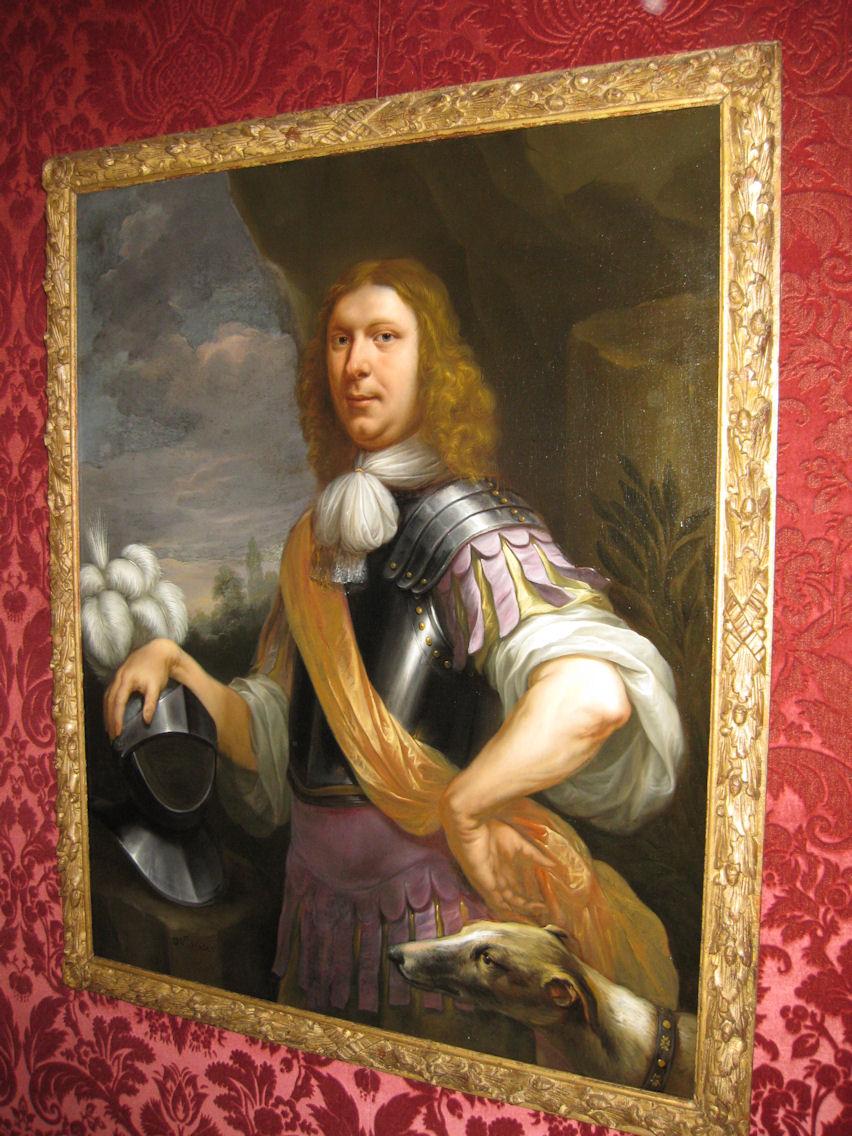
Ter nagedachtenis aan Kapitein Visser, zijn schilderij in kleur zoals dat in het stadhuis van Enkhuizen hangt.
~~
In memoriam Capt. of the Marines Visscher, depicted in colour on a painting, now in the city hall of Enkhuizen.

 Posts