maandag 4 november 2013

Crisis Antwerpen 2013


Afgelopen zaterdag ging het redactieteam naar de wargames beurs Crisis in Antwerpen, waar we onder meer spraken met Barry Hilton van het League of Augsburg forum en natuurlijk Nick Eyre van North-Star die een fraaie tafel had met daarop zijn collectie 1672 figuren.

Wow!

~

Last Saturday the editors went to Antwerp to the Crisis wargames convention of the Tin Soldiers of Antwerp. We met a lot of people, saw a lot of nice things, bought some stuff and enjoyed Belgian beer.

We also met Barry Hilton of the League of Augsburg forum and we had a nice chat with Nick Eyre of North-Star, the figure company that brings us the 1672 25/28mm scale figures of the Franco-Dutch wars. The terrible thing was, at the time we left it turned out to be mr Belaubre himnself was in Antwerp, but I missed him. Meh!

Mr Eyre asked me if there was some kind of publication pending about the first Franco-Dutch war, giving some broad information about the belligerents. We know there is no work yet that covers the period in full, maybe "Les Armees" by Belaubre, but that could be a but dated.

Unfortunatly there is no central register or authority about troops, weapons, uniforms and flags in the Netherlands, as there was no central government in the first place!

The sources are scattered around the country and Europe in the Provincial Archives, the National Archive, the Royal Archives, German Archives (there was a lot of quarrel after William III died about his inheritance between the Frisan Nassau's and the related Prussian Royals), French archives..well you get the picture. It takes a lot of time and effort to work out a single detail, so a book won't be out in the near future, but eventually it will.

In the meantime..if you paint your figures blue for the Frisian and Holland Guards, you won't be far off. Red coats, yellow coats, green coats, all of them are possible!

If a reader of our blog has specific questions, don't hesitate to drop us an email at rampjaar@gmail.com!

woensdag 9 oktober 2013

Aardenburg V


Met dank aan het boek van Fruin van hieronder (p. 217), een verwijzing naar Valkenier's Verwerd Europa over de mislukte berenning van Aardenburg door Nancre. Volgens Fruin dreef eerzucht en vage orders Nancre naar Staats-Brabant over Spaans grondgebied en dacht hij dat Aardenburg een makkelijke prooi was. Niet dus, en een fraaie opsteker voor het moreel in de Nederlanden.

~

The above pages are from Petrus Valkenier's "Verwerd Europa", and tells about the attack on the small town of Aardenburg. According to Fruin, in the book below p. 217, Nancre attacked the Netherlands from the Sout, Ath, where he was garrisonned, for glory and an attack on Staats-Brabant, hereby invading Spanish soil. It didn't work out as planned, as Aardenburg held it's own which was a great boost for morale.


Robert Fruin: de oorlog van 1672


Dit is erg leuk: het boek van Robert Fruin over 1672 is door hem on-line op Google books gezet, zodat een ieder gratis ende voor niks dit fraaie werkje kan lezen.
Hier is de link.

(klik dus op het woord link boven..)

~


This is good news who can read dutch. Diplomat and historian Robert Fruin released his book on 1672 on-line AND free on google books. From p.349 you can read the literature list with Dutch, French and English works, which can help your further studies.

Here's the link.

maandag 30 september 2013

Oorlogsgraven ~ War graves


In een bocht van het riviertje de Drait, ingeklemd tussen een paar nieuwbouwwijken van Drachten, liggen drie veldgraven uit 1672. In de volksmond worden ze de Biskopsgrêven (Bisschopsgraven) genoemd. Het zijn echter geen bisschoppen, maar Munsterse soldaten uit het leger van Bernhard van Galen, de bisschop van Münster, die hier begraven liggen. 

Ze zijn gesneuveld in een gevecht met soldaten van Hans Willem van Aylva, belast met de verdediging van Friesland in 1672, die vanaf de Suameerheide opereerde. Waarschijnlijk waren het plunderaars of verkenners, op zoek naar een manier om de Friese (water)linies te omzeilen op hun weg naar Leeuwarden. Ze vonden hun einde toen ze op de verdedigers van de Poalsbrêge (Poolse brug) over de Drait stuitten. Die hadden onder leiding van grietman Haersma van Oudega de weg opgebroken en gebarricadeerd. Over de gedode soldaten is niets bekend. Misschien duidt de naam van de plek waar ze begraven liggen (Ruterpôlle, vrij vertaald 'plaats van de ruiters') erop dat ze cavaleristen waren.

De graven werden in 1880 omheind met een hekwerk. De oude brug is op 11 april 1945 opgeblazen door het verzet. De graven zijn erg verwaarloosd.

~


On the banks of the Frisian river Drait, on the outskirts of Drachten city, are three war graves from 1672. Known locally as the "Bishops Graves", they contain in effect the remains of three soldiers in the service of Bernhard van Galen, Bishop of Münster.

They died fighting troops of Hans Willem van Aylva, who was in charge of the defense of Frisia and who operated out of nearby Suameer Moor. They were probably raiders or scouts, trying to by-pass the Frisian defensive lines on their way to Leeuwarden, the capital. They met their end in a fight with the defenders of the Poalsbrêge (Polish Bridge), a bridge over the river Drait. We have no information on the dead soldiers, the piece of ground where they are buried (Ruterpôlle, "place of the riders") may hint to the fact that they were cavalry.

The graves were restored by the local council in 1880. The old bridge was destroyed by Dutch resistance fighters on April 11, 1945. The graves are in a sorry state.

dinsdag 27 augustus 2013

Groningen 28 augustus 1672


Morgen 28 augustus en dus feest!

~

Tomorrow we celebrate the relief of the siege of Groningen. Picture from the painting by Folkert Bock taken by the editor of this blog. Usually it's a day off, but some of us have to work alas.

vrijdag 23 augustus 2013

Franse Veldheer 1672 ~French field commander 1672


In het kader van de voorstudie van ons boek over 1672, weer eens het boek "Tooneel des Oorloghs" digitaal ter hand genomen. Illustrator van het boek is Romeyn de Hooghe, en toen ik het boek in de UB zelf ter hand (ik raad alle lezers aan om in uw lokale bibliotheek eens een 17e eeuws werk ter hand te nemen en te genieten van het papier en drukwerk) nam was mij al deze prent opgevallen van "Ëen franse veldheer die smeekbeden in ontvangst neemt".

Let op het bijzondere vaandel dat afwijkt van de franse standaardvaandels. Ik kan helaas nog niet het afgebeelde wapen identificeren.

~

We found out that If you are planning to write a book on an historical subject, it not only takes time, but a lot of time. In the course of years we have aquired a lot of books, pamphlets, paintings and articles and we still have to make a visit to several archives and libraries.

Next step is organising the information, and in that process we started picking up "Toneel des Oorloghs" again, a book by Lambertus Sylvius (posh Latin for "Lambert van den Bosch" or in English "Lambert Woods"), illustrated by Romeyn de Hooghe. The picture above shows a part of a print showing miserable civilians pleading with a French commander as part of a series on french atrocities.

Note the colour (=army flag) of the French commander, with the fleur de lis, a coat of arms, and flames from the corner, which is rather different from the normal french colours. Unfortunatly I could not identify the coat of arms yet..


zondag 11 augustus 2013

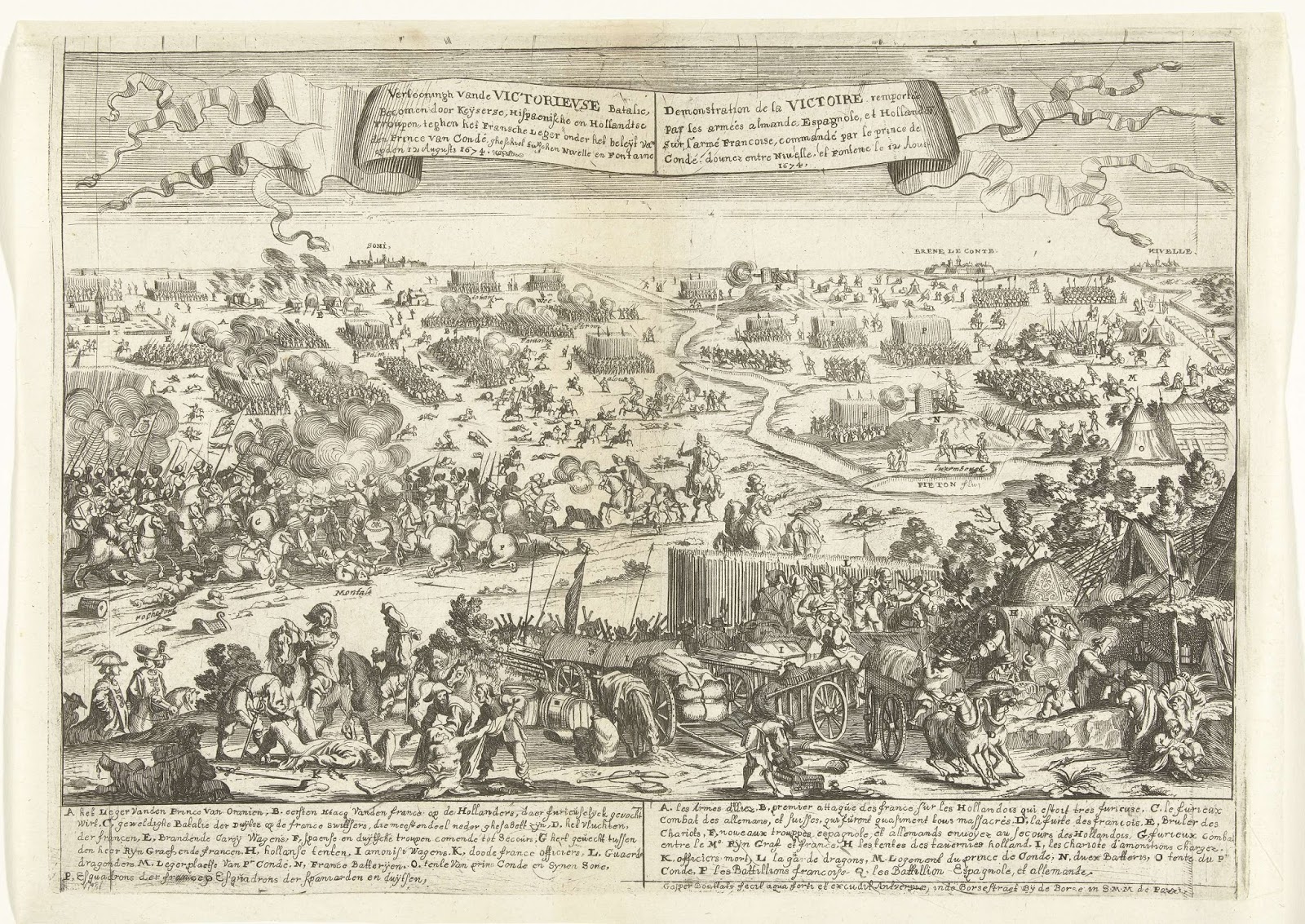
Slag bij Senef(fe) 11 augustus 1674


Vandaag gedenken en herdenken wij de Slag van Seneffe, 11 augustus 1674.
Plaatje komt uit het Rijksmuseum, en is gemaakt door Bouttats.

~

Today in history, the battle of Seneffe, 11th of August 1674, where the Allied army under William III was surprised but held it's own, both sides claiming victory. The picture comes from the collection of the Rijksmuseum, and is made by Bouttats.