Posts tonen met het label 1672. Alle posts tonen

maandag 17 oktober 2022

Geschiedenis 24 over 1672


Quite I while ago I posted a link to an old TV programma, amd after overcoming some technical problems I can repost the video here.  

donderdag 8 oktober 2020

Mauritshuis Collection


This is an undated painting by the Dutch inventor and painter Jan van der Heyden of the city of Veere, probably 17th century, from the Mauritshuis Collection. This Collection is not accessible through the website of the Mauritshuis but through euopeana.eu  (just search with "mauritshuis" and "painting").

Maurits is the dutch equivalent of Maurice, and in this case it's Maurice "The Brazilian", who made his fortune in Brazil, at a certain time a dutch colony. Maurice also had a carreer in the Dutch Army.


zaterdag 9 februari 2019

Helperlinie Groningen


Link to a video file

Above a link to the video file by local TV, in the Helperline, an extra defense line that was build to protect the town of Groningen from the south. The white building is built on a place where there used to be a hill with gallows, which was in 1672 the headquarters of Bishop van Galen.


donderdag 19 juli 2018

De verdediging van Friesland in 1672 en 1673


This is a great book on the fights in the tree Northern Provinces in 1672 and 1673, available free on great Delpher website. It delas with the Frisian Water Defence line, troop strengths, strategy
and gives a lot of praise to Colonel Aylva.


Click here!


donderdag 22 februari 2018

22 februari/February 1672


On this day in 1672, one of the shops/workplace of map maker Johan Blaeu, at the Gravenstraat in Amsterdam, goes up in flames. Fortunately his other shops were saved.

Above a Blaeu map of the city of Groningen, with the 'new' fortifications. The city walls were kept intact until deep in the 19th century, when they were considered obsolete. The walls were torn down, the ditches were filled, and only from abiove you canb see where once the proud walls were standing. The many city gates were demolished, except for one, which is now in the Rijksmuseum collection.

zondag 10 januari 2016

A visit to Amsterdam


Today your editor visited the Amsterdam Rijksmuseum and also the Amsterdam (historical) museum. In the latter I found a painting of the failed storming of Aerdenburg in 1672.

 A bit strange to find it in Amsterdam, but interesting nonetheless. Note the mixed piket/musket units for instance!

donderdag 17 september 2015

Plug bayonet


Een interessante vondst in Tiel van een Franse bayonet uit 1672


Meer over deze vondst hier


~

In Tiel, a town south-east of Utrechtm a French plug bayonet has been found, dating from probably 1672. In the dutch section a link to the dutch article and an interview with the archeologist.


dinsdag 3 maart 2015

Maastricht Fortress of St Peter


This years expedition was to the Limburg Capital of Maastricht were we visited the St Peter Fortress. In 1672 the St Peter Hill was used by the French to bombard the city and near the city using the hill's cave system (the rock is used as a building material), so the Estates General ordered a new fortress to be build to protect the city, which went rather well. In 1701 the fortress with a great view on the surrounding landscape and the river Meuse was finished.


It is also possible to visit the cave system itself but it is not possible anymore to go from the caves to the fortress, as some of the corridors have collapsed.

Maastricht has a lot to offer, some of the old city walls are standing there as well, as the first picture shows.


vrijdag 25 juli 2014

Texel 2014 I


Dit jaar ging het strict wetenschappelijke onderzoeksuitje naar het waddeneiland Texel. We waren er al eens eerder geweest maar hadden lang niet alles gezien, en zo togen we naar het Juttersmuseum in Oudeschild om de maquette van de Reede van Texel te bewonderen. De huisjes en de boten zijn van de firma Artitec die vooral voor modelspoor bouwdozen fabriceert.

Zoals in elk modern museum is het vol met "interactieve" vitrines, films, maar helaas met een slecht uitgeruste museumwinkel.

~


This year, our science expedition took us to the Dutch island of Texel, (wiki entry here) and this time we visited tw sites: first of all, the Juttersmuseum in Oudeschild, which houses a modern museum where marine archeology finds are stored and displayed, but also a diorama of the Texel Roads, where ships laid waiting for supply and favorable winds. There's a fine painting of Backhuysen about it, on which we reported earlier.

The diorama is made by the Dutch firm Artitec, most notably known for its range of dutch HO scale train buildings.


donderdag 15 mei 2014

Spaanse uniformen / Spanish period uniforms


Het was - denk ik - in 1671 wel duidelijk dat er wat broeide in Frankrijk. Als je de kranten van toen op na leest (hierboven de London Gazette) bruist het van de militaire activiteiten. Weer eens wat uniform informatie, en ditmaal over de Spaansen: grijze jassen met rode omslagen. Meer is er niet, dis de hoeden en de pluimen konden alle kleuren zijn, met als de vesten en de sokken.

~

It is my humble opinion that around 1671 it was quite clear that the French were planning something. Contemporary newspapers start to report on military matters more and more and the London Gazette reports in may and juni 1671 about the new uniforms for the Spanish troops: grey with red facings for the coats. It's a start..


maandag 4 november 2013

Crisis Antwerpen 2013


Afgelopen zaterdag ging het redactieteam naar de wargames beurs Crisis in Antwerpen, waar we onder meer spraken met Barry Hilton van het League of Augsburg forum en natuurlijk Nick Eyre van North-Star die een fraaie tafel had met daarop zijn collectie 1672 figuren.

Wow!

~

Last Saturday the editors went to Antwerp to the Crisis wargames convention of the Tin Soldiers of Antwerp. We met a lot of people, saw a lot of nice things, bought some stuff and enjoyed Belgian beer.

We also met Barry Hilton of the League of Augsburg forum and we had a nice chat with Nick Eyre of North-Star, the figure company that brings us the 1672 25/28mm scale figures of the Franco-Dutch wars. The terrible thing was, at the time we left it turned out to be mr Belaubre himnself was in Antwerp, but I missed him. Meh!

Mr Eyre asked me if there was some kind of publication pending about the first Franco-Dutch war, giving some broad information about the belligerents. We know there is no work yet that covers the period in full, maybe "Les Armees" by Belaubre, but that could be a but dated.

Unfortunatly there is no central register or authority about troops, weapons, uniforms and flags in the Netherlands, as there was no central government in the first place!

The sources are scattered around the country and Europe in the Provincial Archives, the National Archive, the Royal Archives, German Archives (there was a lot of quarrel after William III died about his inheritance between the Frisan Nassau's and the related Prussian Royals), French archives..well you get the picture. It takes a lot of time and effort to work out a single detail, so a book won't be out in the near future, but eventually it will.

In the meantime..if you paint your figures blue for the Frisian and Holland Guards, you won't be far off. Red coats, yellow coats, green coats, all of them are possible!

If a reader of our blog has specific questions, don't hesitate to drop us an email at rampjaar@gmail.com!

woensdag 9 oktober 2013

Robert Fruin: de oorlog van 1672


Dit is erg leuk: het boek van Robert Fruin over 1672 is door hem on-line op Google books gezet, zodat een ieder gratis ende voor niks dit fraaie werkje kan lezen.
Hier is de link.

(klik dus op het woord link boven..)

~


This is good news who can read dutch. Diplomat and historian Robert Fruin released his book on 1672 on-line AND free on google books. From p.349 you can read the literature list with Dutch, French and English works, which can help your further studies.

Here's the link.

maandag 30 september 2013

Oorlogsgraven ~ War graves


In een bocht van het riviertje de Drait, ingeklemd tussen een paar nieuwbouwwijken van Drachten, liggen drie veldgraven uit 1672. In de volksmond worden ze de Biskopsgrêven (Bisschopsgraven) genoemd. Het zijn echter geen bisschoppen, maar Munsterse soldaten uit het leger van Bernhard van Galen, de bisschop van Münster, die hier begraven liggen. 

Ze zijn gesneuveld in een gevecht met soldaten van Hans Willem van Aylva, belast met de verdediging van Friesland in 1672, die vanaf de Suameerheide opereerde. Waarschijnlijk waren het plunderaars of verkenners, op zoek naar een manier om de Friese (water)linies te omzeilen op hun weg naar Leeuwarden. Ze vonden hun einde toen ze op de verdedigers van de Poalsbrêge (Poolse brug) over de Drait stuitten. Die hadden onder leiding van grietman Haersma van Oudega de weg opgebroken en gebarricadeerd. Over de gedode soldaten is niets bekend. Misschien duidt de naam van de plek waar ze begraven liggen (Ruterpôlle, vrij vertaald 'plaats van de ruiters') erop dat ze cavaleristen waren.

De graven werden in 1880 omheind met een hekwerk. De oude brug is op 11 april 1945 opgeblazen door het verzet. De graven zijn erg verwaarloosd.

~


On the banks of the Frisian river Drait, on the outskirts of Drachten city, are three war graves from 1672. Known locally as the "Bishops Graves", they contain in effect the remains of three soldiers in the service of Bernhard van Galen, Bishop of Münster.

They died fighting troops of Hans Willem van Aylva, who was in charge of the defense of Frisia and who operated out of nearby Suameer Moor. They were probably raiders or scouts, trying to by-pass the Frisian defensive lines on their way to Leeuwarden, the capital. They met their end in a fight with the defenders of the Poalsbrêge (Polish Bridge), a bridge over the river Drait. We have no information on the dead soldiers, the piece of ground where they are buried (Ruterpôlle, "place of the riders") may hint to the fact that they were cavalry.

The graves were restored by the local council in 1880. The old bridge was destroyed by Dutch resistance fighters on April 11, 1945. The graves are in a sorry state.

vrijdag 23 augustus 2013

Franse Veldheer 1672 ~French field commander 1672


In het kader van de voorstudie van ons boek over 1672, weer eens het boek "Tooneel des Oorloghs" digitaal ter hand genomen. Illustrator van het boek is Romeyn de Hooghe, en toen ik het boek in de UB zelf ter hand (ik raad alle lezers aan om in uw lokale bibliotheek eens een 17e eeuws werk ter hand te nemen en te genieten van het papier en drukwerk) nam was mij al deze prent opgevallen van "Ëen franse veldheer die smeekbeden in ontvangst neemt".

Let op het bijzondere vaandel dat afwijkt van de franse standaardvaandels. Ik kan helaas nog niet het afgebeelde wapen identificeren.

~

We found out that If you are planning to write a book on an historical subject, it not only takes time, but a lot of time. In the course of years we have aquired a lot of books, pamphlets, paintings and articles and we still have to make a visit to several archives and libraries.

Next step is organising the information, and in that process we started picking up "Toneel des Oorloghs" again, a book by Lambertus Sylvius (posh Latin for "Lambert van den Bosch" or in English "Lambert Woods"), illustrated by Romeyn de Hooghe. The picture above shows a part of a print showing miserable civilians pleading with a French commander as part of a series on french atrocities.

Note the colour (=army flag) of the French commander, with the fleur de lis, a coat of arms, and flames from the corner, which is rather different from the normal french colours. Unfortunatly I could not identify the coat of arms yet..


dinsdag 12 maart 2013

1672 Commissie lijst ~ Commission list


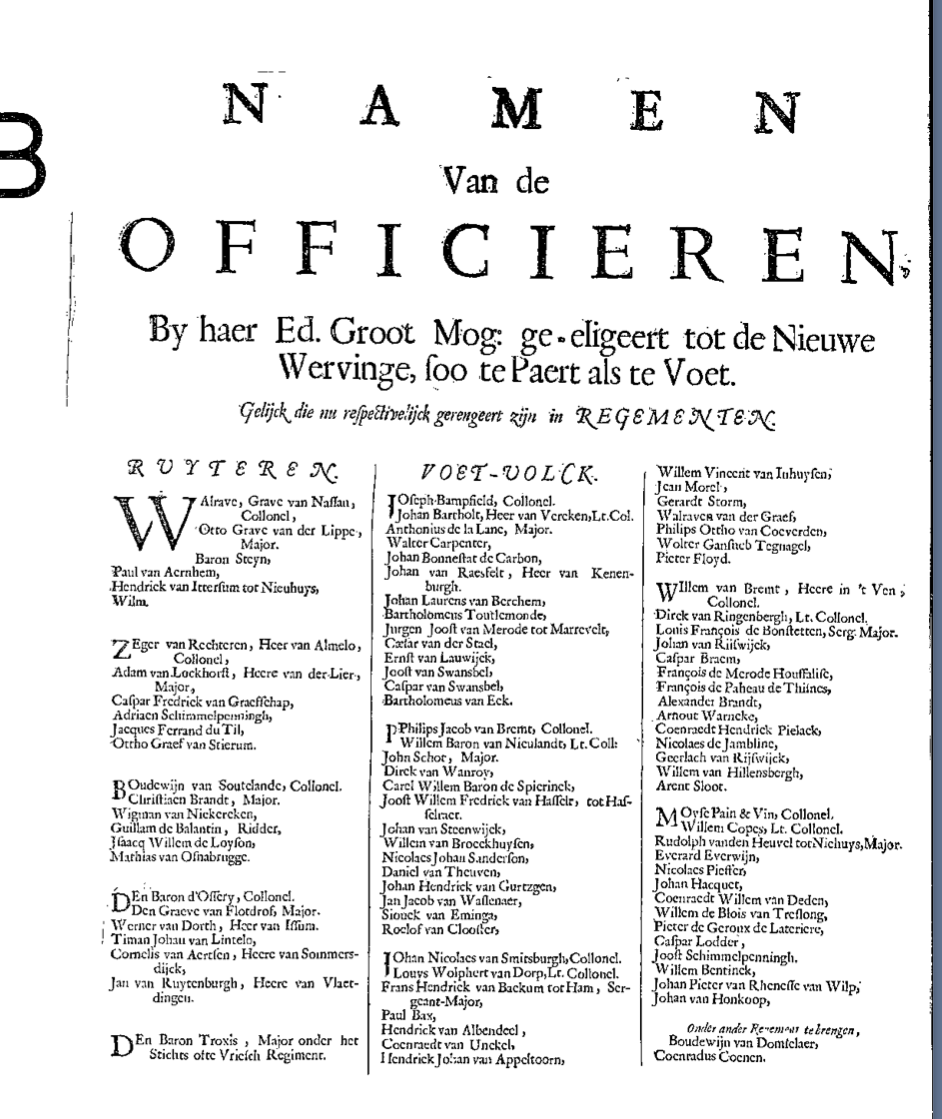
Uit de KB pamfletten collectie, Knottel nr 09997B, een lijst van "officieren" die regimenten mochten werven. Opvallend het grote aantal Franse namen.

~

From the Dutch Royal Library, Knottel Pamphlet KB 09997B, presenting a list of officers that were allowed by the States to form a regiment.

dinsdag 26 februari 2013

Franse Legerorganisatie ~ French Order of Battle


Onze grote dank gaat uit naar Mr F. Coupeau (overigens auteur van een leuk bordspel over de slag bij Nieuwpoort 1600) voor de volgende sterkte-informatie over het Franse leger in de 17e eeuw.

~

A very, very big thanks goes out to Mr F. Coupeau (amongst many things the author of a boardgame on the Nieuport battle of 1600), who kindly offered some great offer on the company/bataillon strength of the French Army of the 17th century.


donderdag 31 januari 2013

Aardenburg IV


Het onderwerp Aardenburg is al eerder op dit blog aan de orde geweest. Ik heb daarbij gebruik gemaakt van het boek van G.A. Vorsterman van Oyen. De heer C. Bruens uit Zeeland wees mij echter op het volgende: de kaarten die van Oyen heeft gebruikt zijn NIET uit 1672 maar een reconstructie gebaseerd op Dresselhuis. Over de berenning van Aardenburg meldt de heer Bruens het volgende:

Op het moment van de berenning (dus zeker geen beleg) hebben de Fransen een kapitale strategische fout gemaakt. Waarschijnlijk waren zij geïnformeerd dat de stad nagenoeg onbewoond was en dat er weinig weerstand te verwachten viel. Via de noordzijde aanvallen maakte een omtrekkende beweging noodzakelijk en zou zorgen voor natte voeten aangezien dit gebied door de vele inundaties uit het verleden tot een soort permanent moeras was verworden. De Fransen hebben op goed geluk besloten alle manschappen tegelijkertijd de wallen te laten bestormen (berennen). Zij kwamen door hevig vuur van Aardenburgse zijde vast te zitten in een halve maan. Na een korte wapenstilstand om gewonden en doden te bergen en gevangenen af te voeren naar de kerk, besloten de Fransen het nog een keer op exact de zelfde wijze te proberen met catastrofale gevolgen en een victorie voor het kleine stadje tot gevolg.

De prent boven slaat op de heldhaftige actie van de heer Spindler tegen de Fransen in Vlaanderen. Ter ere van hem is een paadje genoemd in Aardenburg.

Ik heb me altijd afgevraagd wat de Fransen nu precies deden in Aardenburg. Het grote Franse leger trok immers via Luik en Limburg naar Gelderland, Utrecht en Holland en Aardenburg is wel een eind uit de buurt. Ik denk dat oplossing aldus is. Uit het boek Leven en Bedrijf van Willem Henrik van Arnoldus Montanus, google boek hier, weten we dat de commandant van de Franse troepen Markgraaf de Nancre was, die zetelde in Ath. Uit Montanus boek (p. 506 e.v.) weten we dat de Fransen via Deinse naar Aardenburg trokken en daar werden tegengehouden.

De Markgraaf de Nancre komen we ook tegen in George Satterfields's Princes Posts and Partizans, google boek hier, die in de Hollandse Oorlog regelmatig vanuit Ath de Spaanse Nederlanden teisterde. Het is dan ook aan te nemen dat het reisje van de Markgraaf een afleidingsmaneuvre was, met als leuke bijkomstigheid het onderweg innen van contributie in de toen nog redelijk zwak verdedigde Spaanse Nederlanden.

Hieronder een kaartje van het rampgebied.


We have posted several messages on the French attack on Aardenburg in 1672. In one of my post I used a map from the book by G.A. Vorsterman van Oyen.
One of our readers, Mr C. Bruens, kindly pointed out to me that the map is in fact a 19th century reconstruction, based on a book published by the Utrecht printer Dresselhuis. On the attack on Aardenburg mr Bruens writes:

"The French made astrategic error when they attacked Aardenburg. It wasn't a siege in the true sense of the word but more of a surprise attack. Thet were probably misinformed about the state of the town and probabably thpight it wasn't inhabited and little resistance was expected. A move around to and attack from the north would be impossible as that part of the terrain was swamped because of ealier inundations. probably the French tried their luck by storming the walls in the south, but got stuck from fire from the troops in the fortress town from a half moon trench. After a shor cease fire another attack ended with the same fate and the French ran off."

The print in the top of this post tells about a succesfull attack on French fortifications in the South. The attack in 1672 on Aardenburg can be traced back to the town of Ath, where Marquis de Nancre had his headquarters. From Ath several raids where made in the Spanish Netherlands, terrorising its habitants for contribution and therefore paying indirectly the French army, and we think the attack on Aardenburg was a bridge to far in 1672.

For more info this old google book and this book by George Satterfield.


zondag 16 december 2012

Louis XIV


Toen enige jaren geleden Mark Copplestone met zijn 1672 figuren begon, was dat voor uw redacteuren een van de redenen met dit blog te starten. Mark heeft de figuren overgedaan aan North Star en daar werden nog meer figuren uitgebracht. Als klapstuk Lodewijk XIV himself! De website met nog meer figuren is hier...

~

Mark Copplestone's 1672 range (Glory of the Sun) of 28mm miniatures was one of the reasons to start this blog a few years ago. Mark's range has been taken over by North Star who have expanded the range and now have released the Man Himself, King Louis Quatorze on horseback. Check out North Star's website here..


maandag 5 november 2012

Grave Museum II


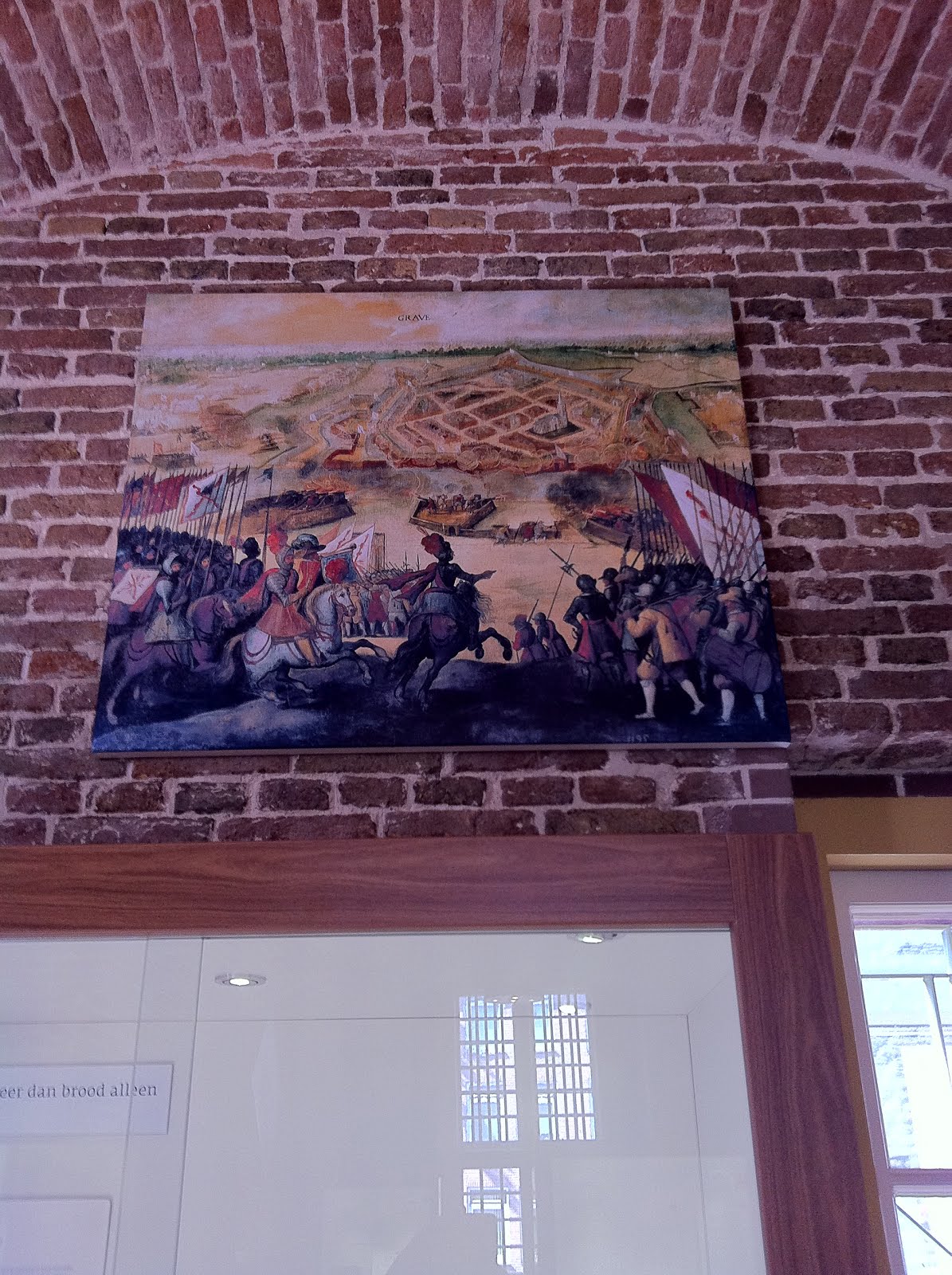
En nog wat meer foto's in en om het Graafs Museum. De derde afbeelding is ene uitvergroting van een prent die een van de belegen laat zien uit de 80 jarige oorlog met aan de ene kant de Spanjaarden en aan de andere kant de mislukte stadhouder Leicester. Bijzonder is, dat de prent in kleur is. Het origineel ligt in Hongarije (gaven geen thuis) maar het Brabants Historisch Centrum was wel zo vriendelijk mij wat meer info te geven.

Natuurlijk mag een kanon niet ontbreken..


~

Some more pics we took in and around Grave. The third pic, in colour!, shows the siege between the Earl of Leicester, the rather unsuccesfull English Stadholder, and the Spanish and naturally there's got to be a gun!

Grave Museum I


Wat afbeeldingen van Grave uit heden en verleden met wat foto's van maquettes in het museum in Het Graafs Museum. Het museum verkoopt ook boeken over lokale geschiedenis, en ook over de militaire geschiedenis van een van de meest belegerde steden van ons land.

~

Some pictures from our excursion to the fortress town of Grave, one of the most besieged towns of the Low Countries, which - as wel all know of course - was captured by the French in 1672 who made an exemplary effort to hold the town against Rabenhaupt and finally William III. Grave lies strategically near the Meuse River and guards one of the entrances to the Province of Guelders and the rest of the country.

Unfortunatly few is left of the fortress defenses but one of the town gates has been restored.

The Graafs Museum is small, but has some very nice models of the various castles and defences. The museum also sells books on local and local military history.